


Patrick Déziel, a former agency art director for 25 years, now creates relief works where abstraction, landscape and geometry converge. Between the rigor of urban architecture and the freedom of mountain peaks, he sculpts wood with a laser, then adds paint and resin.
If you had to introduce yourself to someone discovering your work for the first time, what would you tell them?
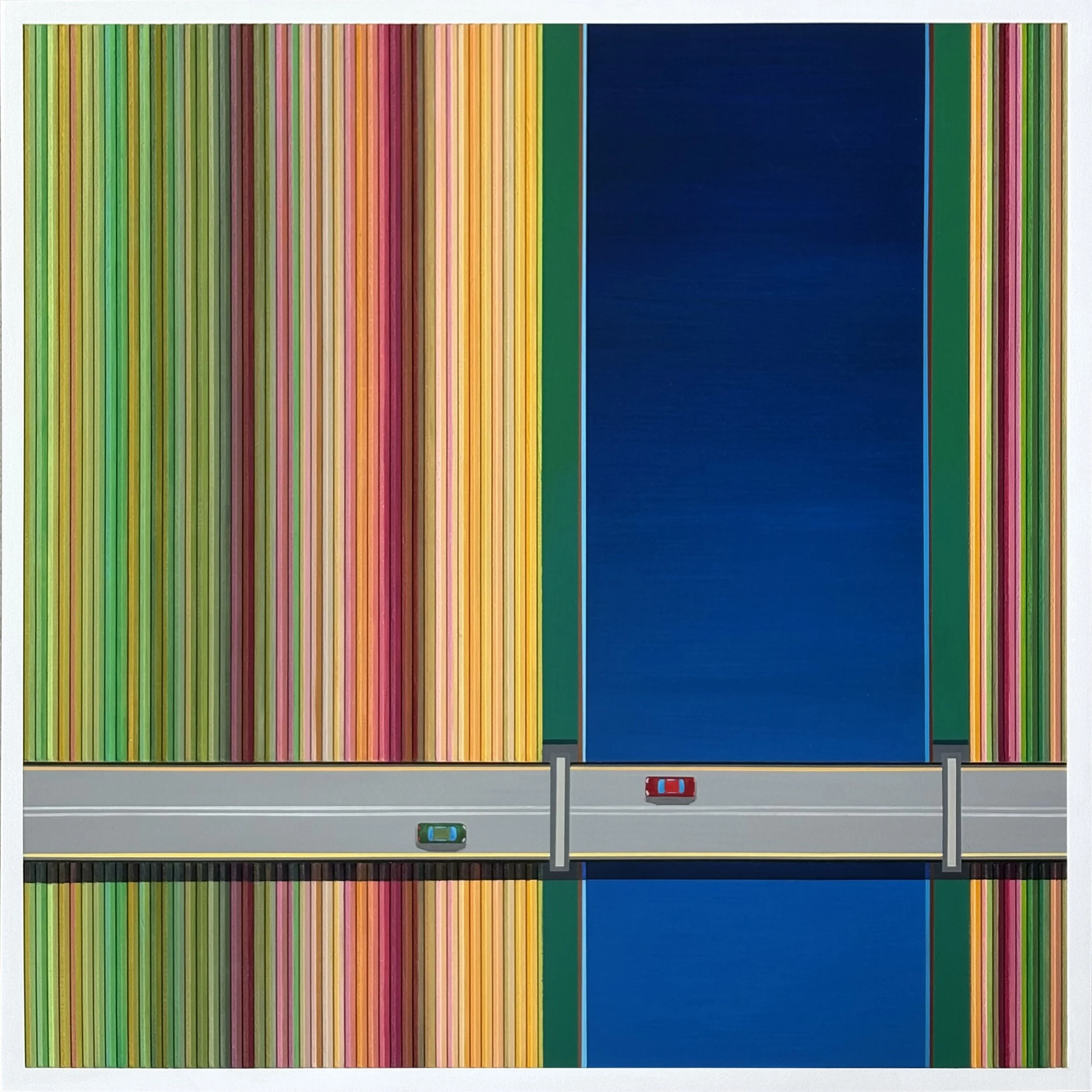
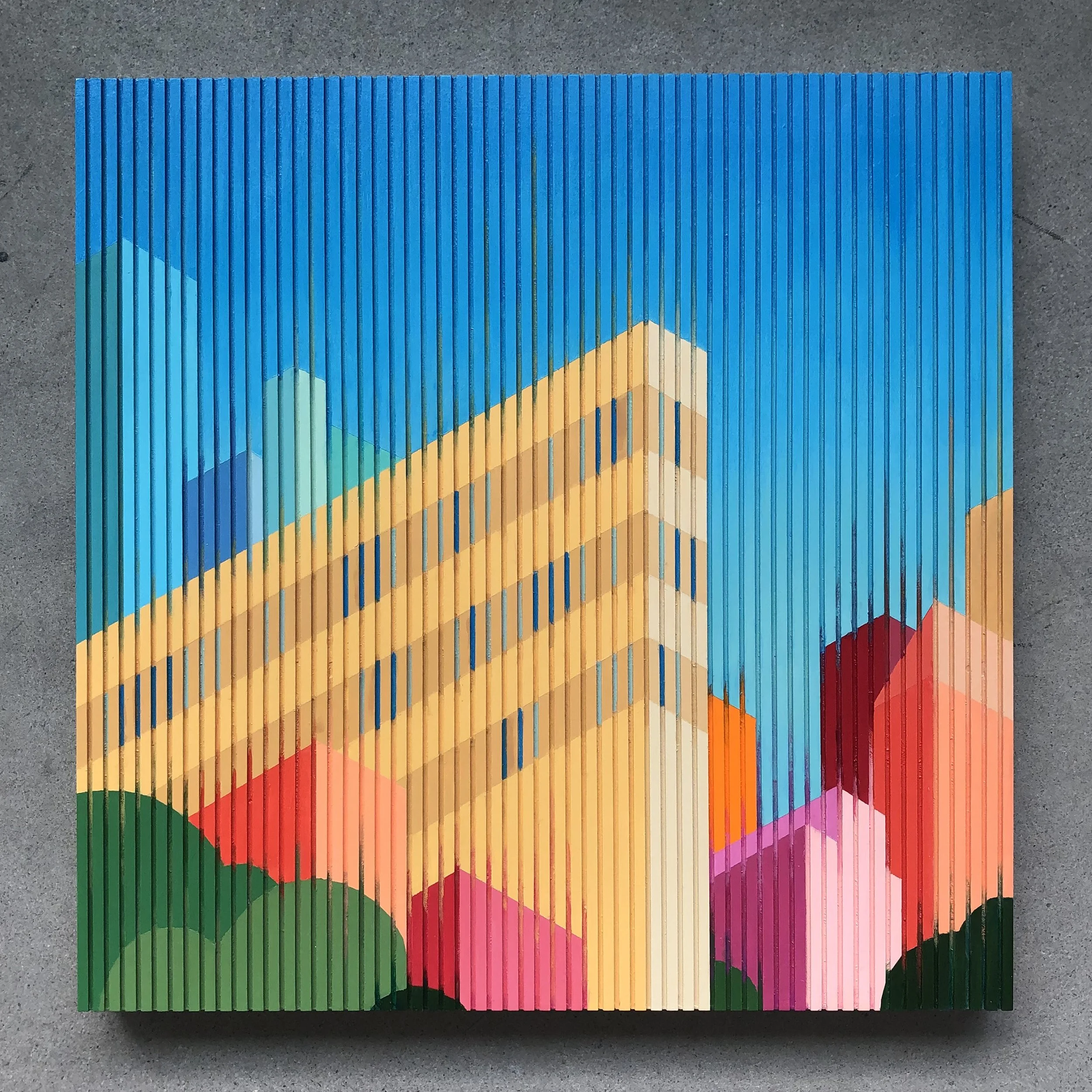
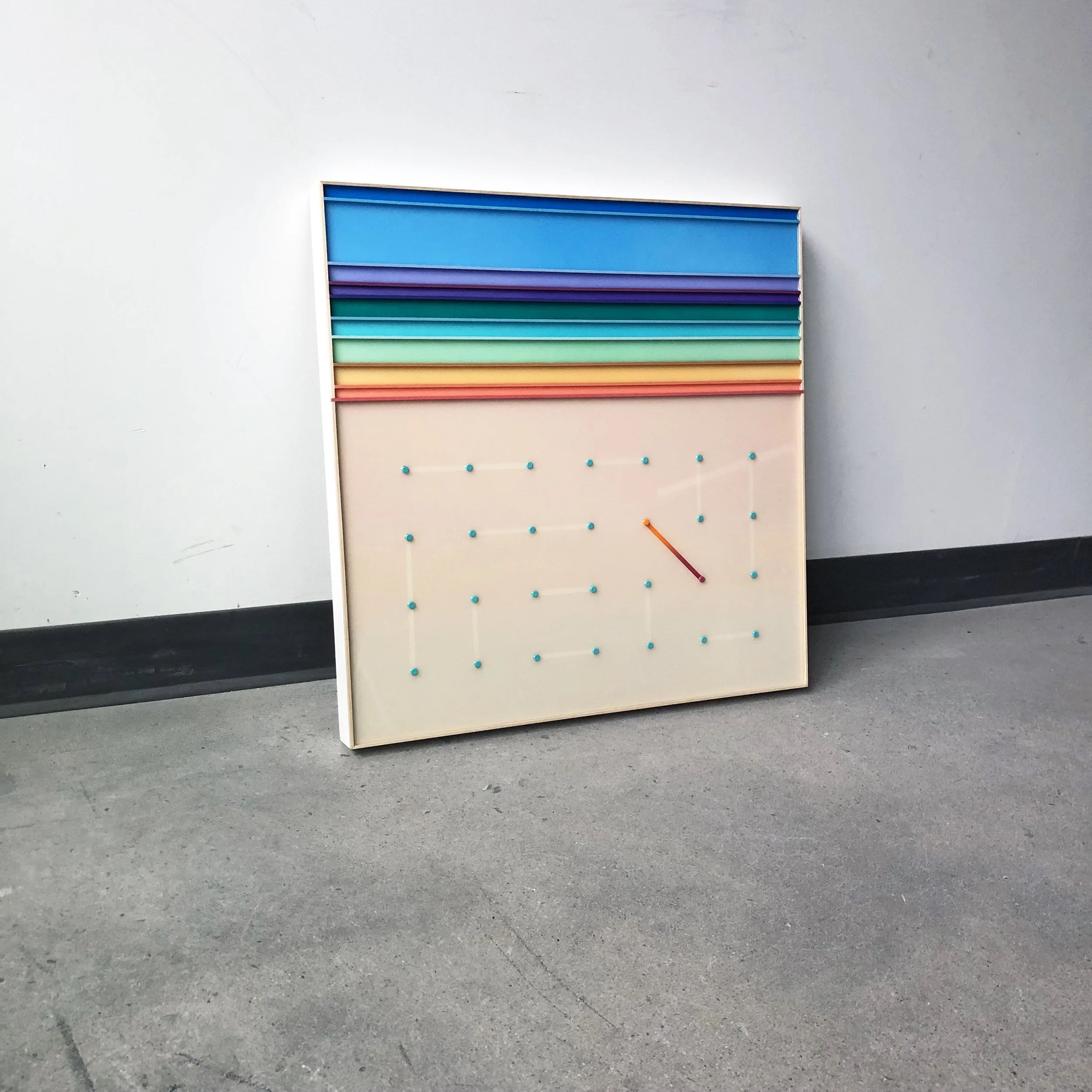
My work lies at the intersection of abstract art, landscape and geometric design. My primary goal is to transform the surface of a painting into a three-dimensional space, where lines, colours and light come together to create a composition that is both structured and alive. I work primarily on wood panels that I “sculpt” using laser-cutting technology. I enrich my work with acrylic paint, wooden elements and coloured resin, depending on the collection. At the beginning of my practice, all the cutting and gluing of the wooden strips was done by hand, an enormous amount of work to achieve a flawless relief effect. Now, I optimise my time through assembly and mixed-media techniques, allowing me to push my ideas even further.
Does your background in agency art direction still influence your artistic practice today? In what way?
I would say yes, in the sense that my work is very graphic. I am always searching for the best possible composition, both in terms of structure and colour arrangement. I also quickly sketch each idea on paper, then on the computer in vector form, before beginning production on the wood panel. This allows me to explore and modify different directions more efficiently. In other words, the creative process and the various production techniques I learned during my 25 years in art direction constantly serve me in the execution of my work and also help my practice evolve towards new horizons.
After more than twenty years in digital design, what prompted you to return to physical and tangible mediums?
In an agency, a great deal is expected of a creative professional in terms of ideation and production performance. However, creativity often suffers under these performance demands. I have never had a problem coming up with ideas; I have tonnes of them tucked away in my drawer. But I felt as though I was being squeezed dry to keep up with the pace of projects and technological evolution. I wanted to reconnect with hands-on practice, return to the basics and live with less pressure.
You find inspiration in both urban architecture and mountain hiking. How do these two seemingly opposing worlds coexist in your work?
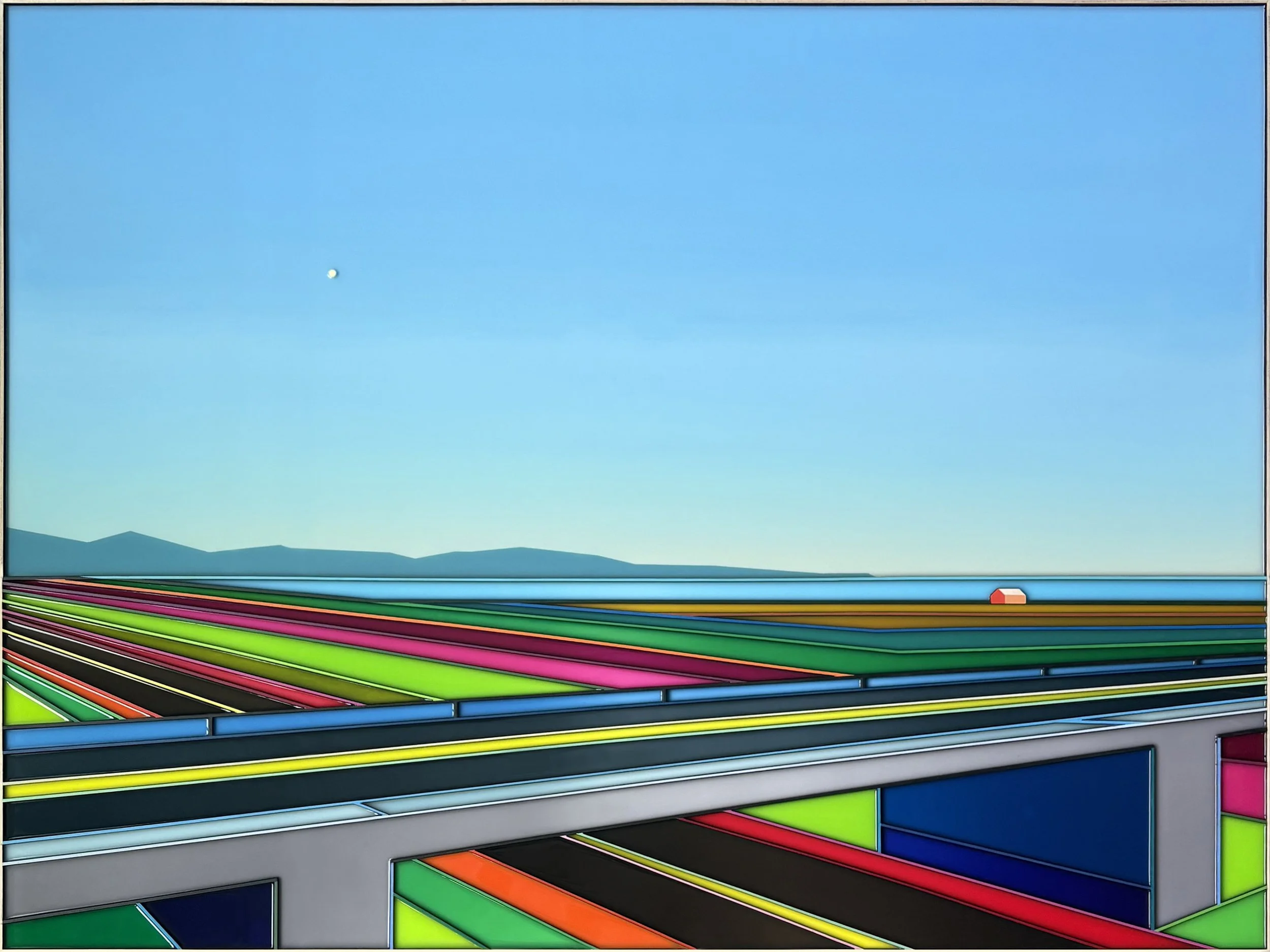
Inspiration comes as much from walking through city streets and observing their architecture and infrastructure as it does from hiking in the mountains, where light, colours and wide-open spaces invite contemplation. The city stimulates the mind through its structure, precision and clean lines. Mountain hikes, on the other hand, open up space, soothe the eye and evoke a freedom that escapes the constraints of geometry. Rather than choosing between the two, I seek to balance my work through different collections. In my pieces, raised lines, divisions within the composition, colours and plays of perspective become connecting elements between these two worlds. Geometry gives structure to the landscape, while nature brings depth and emotional dimension to that structure. Ultimately, this coexistence also speaks to the human condition. We build, organise and transform our environment, yet remain deeply connected to nature. We need the city to come together, create and move forward, just as we need wide-open spaces to recharge, gain perspective and regain a certain balance. It is in this space between the built and the natural, between precision and freedom, that my work takes shape.
Can you describe your artistic process, from the initial idea to the completion of a piece?
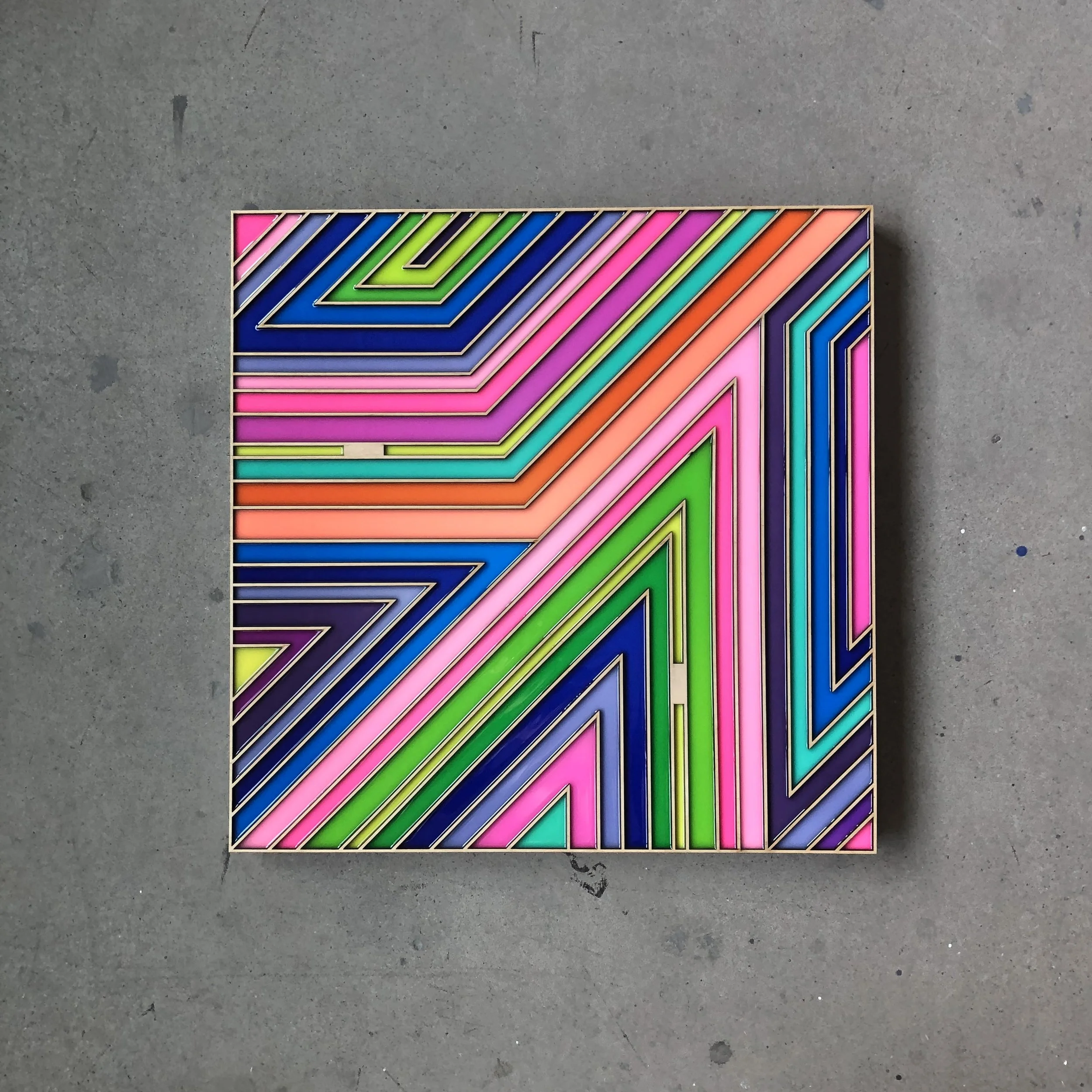
It all starts with an idea, a flash or a trigger that can occur anytime, anywhere. Let me give you an example: during a recent trip to Sicily, we hiked up Mount Etna, and at the summit, the texture of the volcanic rocks combined with the sulphur from the gases looked like fluorescent green and yellow lichen moss. The entire rocky surface of the volcano was surreal, as if we were on another planet. In short, the atmosphere, textures, colours and relief of the volcano inspired me greatly. I took a great many photos. I jot down certain ideas on my phone or in a sketchbook, depending on the situation. Sometimes I let an idea mature for a while, then draw different compositions on paper before transferring them to the computer with colour options. This computer sketch saves me time, especially when applying colours. The final composition is always unique; I call it “the skeleton”. It must be perfect because it will be engraved onto a wood panel or Russian birch plywood for laser cutting. I then incorporate other mediums, such as wooden pieces or resin, depending on the work. There is always a little improvisation along the way, but the process remains structured and well-defined before I paint or fill in all the surfaces. A piece comes to completion when I begin searching for a title. Sometimes this happens quickly, but at other times it requires a more in-depth search to properly convey what the work inspires in me.
How does Montréal feed your artistic imagination?
I consider myself lucky to live in Montréal, my hometown, a city that nourishes my imagination in a thousand ways. I live practically at the foot of Mount Royal, while being close to downtown and its energy. Between nature and urban architecture, festivals, museums, restaurants, exhibitions and art galleries, sources of inspiration are everywhere. But perhaps Montréal’s greatest wealth lies in its human and cultural diversity. It is a vibrant, outward-looking city where people from here and elsewhere come together, from artists with singular worlds to bold creators and curious minds. Being part of such a creative community constantly offers me new perspectives, feeds my curiosity and stimulates my desire to explore. For me, Montréal is much more than a place to live: it is a space for research, encounters and discoveries, an environment that fuels my imagination and pushes me to see things differently.
Which artist, architect or designer inspires you the most, and why?
There are several, but since I visited Denmark this summer, I will talk about architect Bjarke Ingels (BIG). What inspires me about Bjarke Ingels is his ability to bring opposing worlds together and transform them into a harmonious whole. He does not see architecture solely as construction, but as a way of creating connections between people, their environment and nature. This vision resonates with my artistic approach. In my work, I seek to bring together the geometry of architecture and the richness of the surrounding natural world. Lines, shapes, colours and relief become a language that unites these two worlds. Like Bjarke Ingels, I am interested in what happens when different elements meet. I seek to create a balance between structure and movement, rigour and spontaneity, the built and the natural. His work inspires me to look beyond oppositions and explore the possibilities that emerge when different artistic approaches come together. In architecture as in art, I believe the most interesting ideas often emerge at the boundary between two or more worlds. During my trip, I visited BIG’s CopenHill project to fully grasp the scale of his vision and its impact on the surrounding environment. In short, CopenHill is a multifunctional social and cultural waste-to-energy facility, where waste is transformed into heat and electricity for all the residents of Copenhagen. Its tall, sloping roof also serves as an artificial ski slope accessible year-round, as well as hiking trails and a climbing wall open to the public. There is also a superb view of the city, a terrace and an après-ski café, all without the cold and snow!
Do you have any upcoming projects or exhibitions you would like to tell us about?
We are currently having a house built in Sutton, in a very inspiring setting where I will have a studio. I plan to be deeply involved in the design and construction of the house. I look forward to getting to know the artistic world of the Eastern Townships, which I know to be rich and diverse. I want to continue exploring different mediums and perhaps even try different styles. At the same time, I must continue meeting the expectations of my gallery owners, who require a steady output of work. Art takes time, and I remain a single artist, with my own limitations and creative pace. I therefore believe the next step will be to bring in assistants to give me more freedom and open up new possibilities. After that, I will let things evolve naturally, at the right time and in the right place.
To discover more of Patrick Déziel’s work: Website & Instagram.
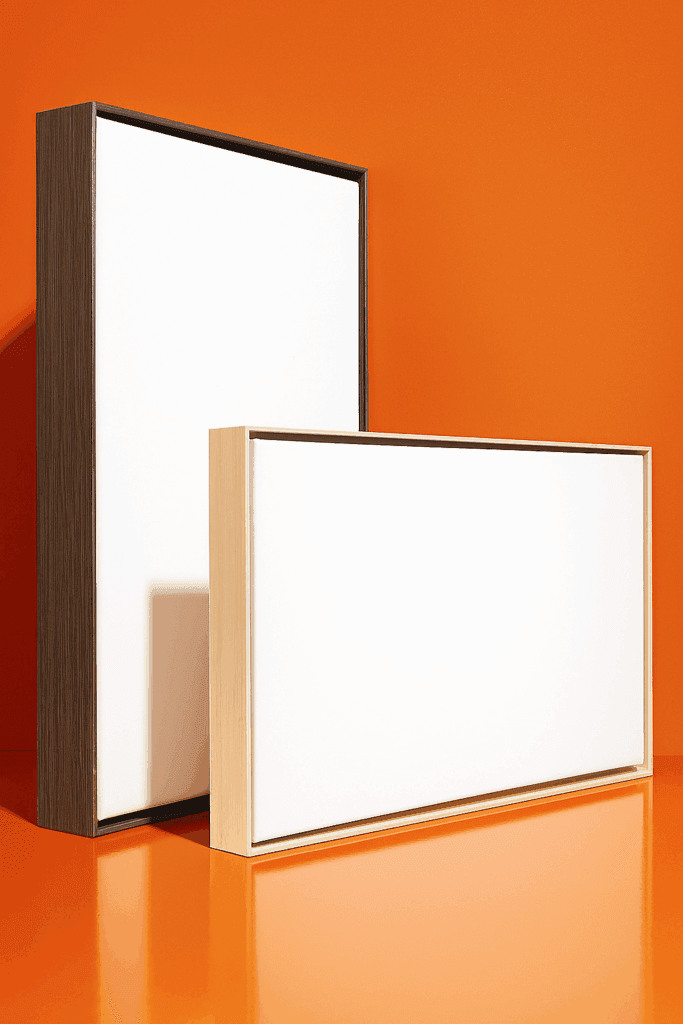
Are you looking for affordable floating frames for your artwork? Kolekin frames are the solution!
Easy to assemble at home.
Affordable (but with a gallery-quality look!).
Free shipping on all orders over $50.
