


Step into the world of Meriam Benkirane. Trained as an interior architect, the Moroccan artist decodes the complexity of our urban modernity. Through a vibrant geometric vocabulary, she explores the invisible systems of society and questions the place of the living in the face of technological effervescence. A meeting with a consciousness in motion.
You trained as an interior architect: how has that background shaped your artist's eye and your artistic practice?
My background in interior architecture nourishes my eye, my process, and my thinking in my current practice.
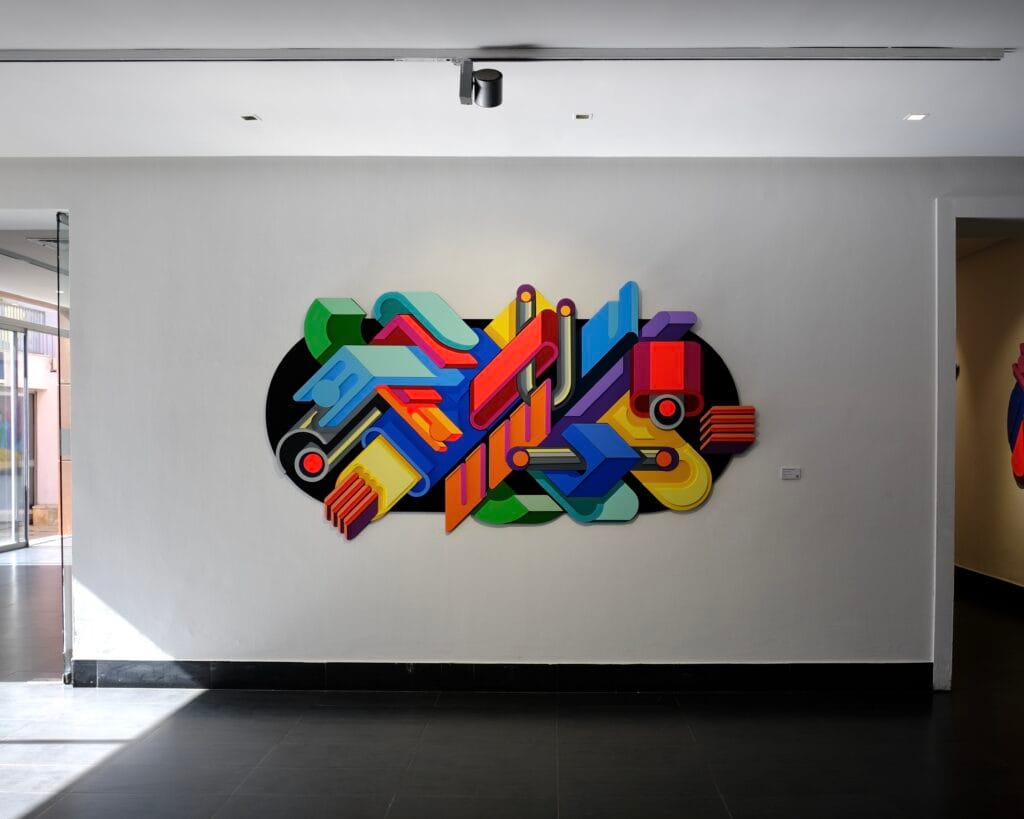
On one hand, from working on interior architecture sites I inherited a way of looking at the inside of a building, its construction, what makes up its systems. For a long time I observed what made up a building during its construction, things that become invisible once it's finished. Cities are built like that too, and so are the ways we function in society: there are always invisible systems governing the visible, and I'm interested in those systems. I try to understand how we function within our urban modernity, and I try to see how we evolve alongside all the changes underway: it's a system that is perpetually changing in its structure.
In my process, this stage of working on buildings also taught me to work in layers, layers that stack on top of each other in my creative work, literally real layers, each one carrying a layer of information or complexity to develop. I also explored 3D drawing, both by hand and through computer modeling; I still use architectural design software for certain stages of my process.
You say you draw on urban effervescence. Tell us about Casablanca and what this city gives you creatively.
I've always seen Casablanca as a laboratory of architecture in full evolution, and that's extremely inspiring to me. I observe the shapes, the styles, the way light falls on buildings, each one from a different era and style, and that feeds the way I express my symbolism and the systems I develop. And then there's its energy, its rapid evolution: the city I grew up in is constantly changing, modernizing, and that speed feeds me.
Where does this vocabulary of geometric shapes and vivid colors, now your signature, come from?
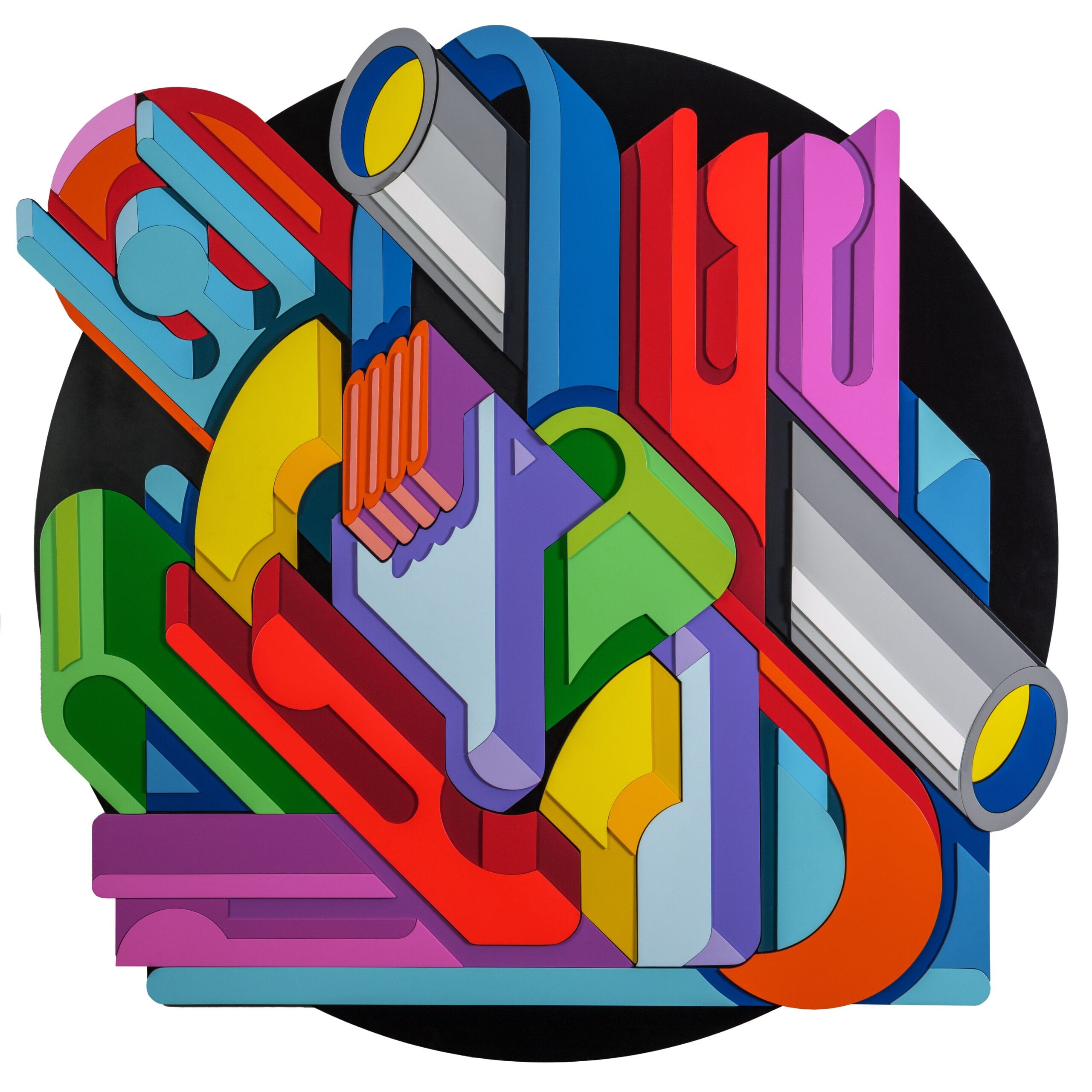
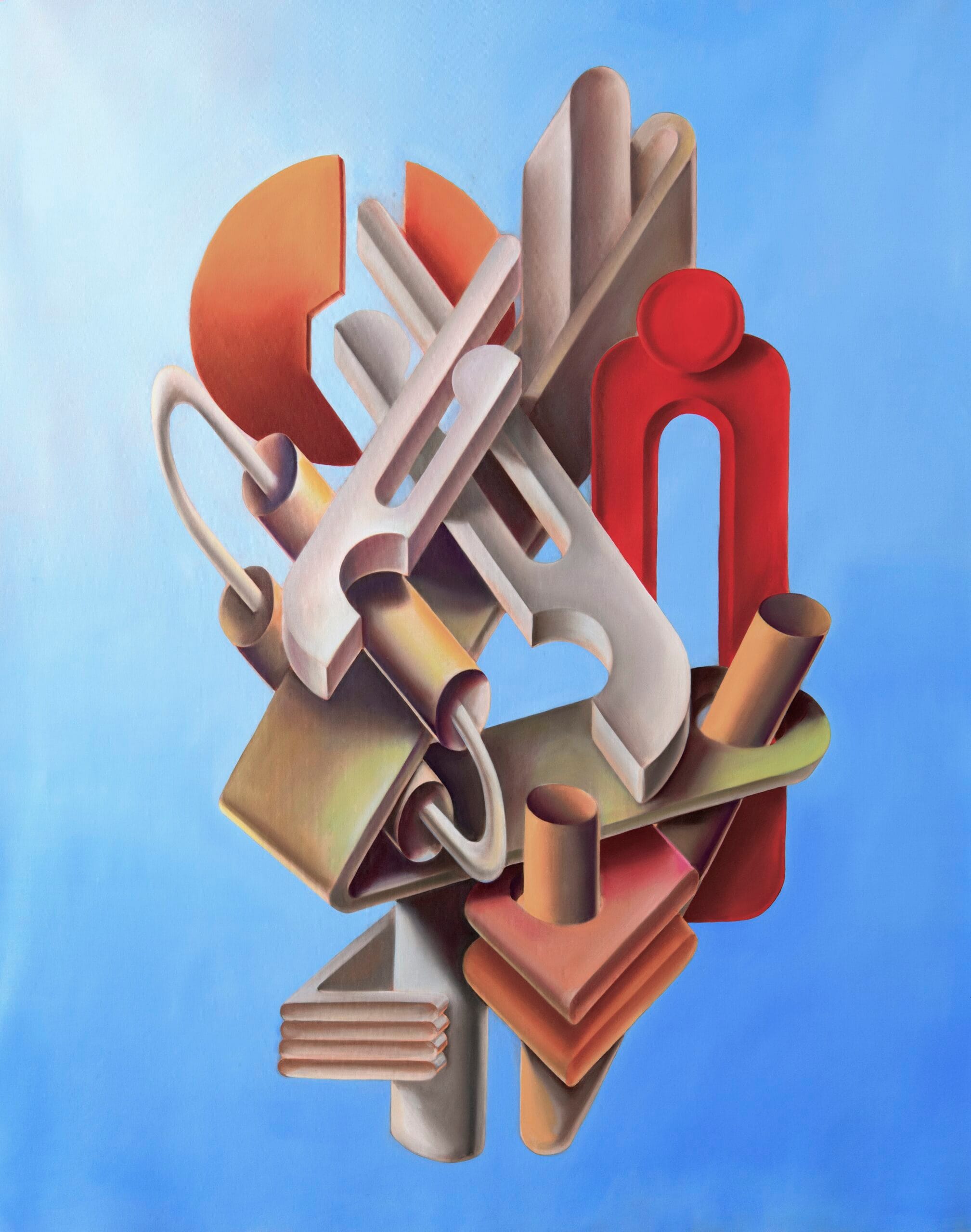
My shapes come from the urban world, from the organic world, and I add a lot of symbolism to them. I draw inspiration from the elements that make up the systems of our urban modernity: buildings, roads, tubes. I add organic elements to that, human forms, my characters, my hands, and I like to juxtapose all of that with a symbolic vocabulary that comes from my mental space, from my perception of certain concepts that I see as images in motion. I like to weave all of this together, as if I were doing a kind of mind mapping that tries to answer existential questions.
My colors reflect the world as it is: vibrant, sometimes saturated, calling out for everyone's attention, trying to sell you something, trying to teach you something, or just trying to be what it is and leave you in awe of its own grandeur. The urban and technological world is an explosion of saturated colors, the inner world is more subtle; I love both, so I paint both.
Your work is often described as a mirror of your analysis of the world. Could you choose one particular piece and show us how this plays out concretely?
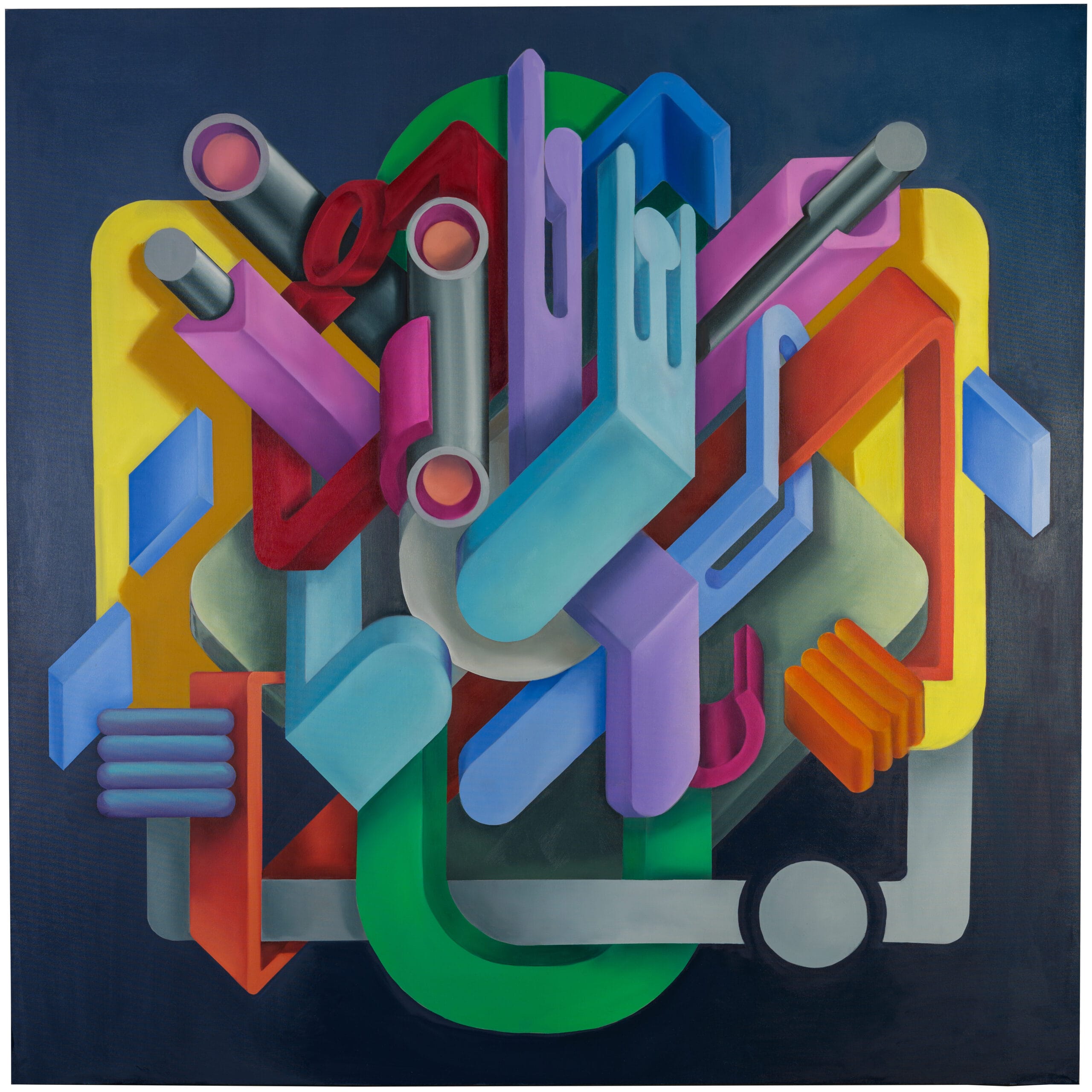
In the painting "Where the Lions Weep" (above), I have two figures at the center. One is whole, with a full head and two arms; the other is only half of himself, but he supports the one in front of him, gives him strength to move forward. These two figures float within a tangle of pink tubes coming out of a building, and platforms that, instead of supporting them, are vertical and held up by human hands, all set against a bright yellow screen that frames them.
For me, this is a symbol of our era: the human relationship is central. Some have more resources than others, whether at the individual level, or at the level of a locality, a country, or the whole world, but the strong are only strong because they use the resources of the weaker. And yet we help each other: that's what humanity has always been. But this humanity is becoming less and less human; it's surrounded by platforms that mimic our relationships while gradually, over time, tending to eliminate them, leaving us with the illusion of a relationship and an inexplicable feeling of unease. We think we're relying on them, but deep down we're relying on the human and the living. The artificial takes over, but at the center, there will always be the living.
Ultimately, I think what interests me is trying to understand all of this, the urban world I live in, understanding its systems. And trying to create systems that work, that answer a question that obsesses me: how can technological and urban progress come together with a deep progress of the living, all living things, not just humans? How could we use all these tools that humanity developed before us?
Your works question the place of humans in the face of new technologies. What is your own relationship to digital tools?
For me, technology needs to be thought through. Except it evolves so fast that by the time you've thought it through, you already need to rethink it. I always try to keep a framework that lets me use it as a tool that amplifies my thinking, my creativity. I use it to observe the world, its trends, to design my works at certain stages; it's very present in my life. But at the same time, I know I fall too easily into its excesses, so I stay vigilant, I try all kinds of systems to protect myself without cutting myself off from it.
For example, for more than a year now, I haven't had social media on my phone; I have it on my tablet, and since I use my tablet for work, that works for me. I use Instagram to find inspiration, to communicate, but I no longer spend hours scrolling: that didn't suit me at all, it took away my ability to think and to be creative. I also know that when I need to paint, I need to be in a certain, clear state of mind. So I make myself follow a kind of technology hygiene before my painting sessions. I feel like my mind gets saturated when I don't set limits on how I use these tools.
I see these tools as amplifiers of my abilities, but ones that can also replace them: as a result, I lose certain skills that I stop exercising if I delegate them. Especially since AI use has become so widespread. I feel it's really important to keep having purely human reflection, which I can then rework and sharpen with an outside tool, but without touching, at its core, what allows me to have thoughts that are truly my own. That part is dangerous for me. I also place great importance on knowing what belongs to me in my mind and my heart, and what doesn't come from me; so I'm careful about what enters through technology. I want it to stay a tool that serves me, not something that drifts, where I become the tool of interests that aren't my own.
In fact, I deeply believe that the space of thought, of consciousness, is sacred: that's where everything is created for the first time. The space of imagination, of creativity, is the cradle of hope, and I want that cradle to stay pure, not invaded by a multitude of voices and agendas. I hold on to defending my mind. So I use AI tools, social media, screens, and so on, but in a way that feels respectful of my mind. And I also question their use and their impact on society: in terms of human relationships, in terms of impact on employment, and the fact that we no longer know how to do the tasks we delegate.
You say you draw on your intuitions and sensations: how does a work concretely come to life for you, from the first idea to its completion?
At the start it's a drawing in my notebook, intuitive, raw. I always carry one of my notebooks with me; the ideal moment for me is when I'm surrounded by people, when it's noisy and I lose myself in the noise, that's a way for me to clear my mind. Then I add colors or not, depending on the drawing, on what it's telling. Sometimes I like to let it express itself in pure composition, sometimes it needs color.
Name an artist who inspires you, and why.
I really love the work of Jason Boyd Kinsella; he paints psychological landscapes. He works in oil using old-master techniques while being very modern in his subject matter and practice, and that inspires me. I feel close to his practice because he paints the emotional landscapes of individuals and I paint systems that tell the story of an era. He paints individual complexity and I paint collective complexity. And then, on a purely irrational level, his work touches me deeply.
Do you have any upcoming projects or exhibitions you'd like to tell us about?
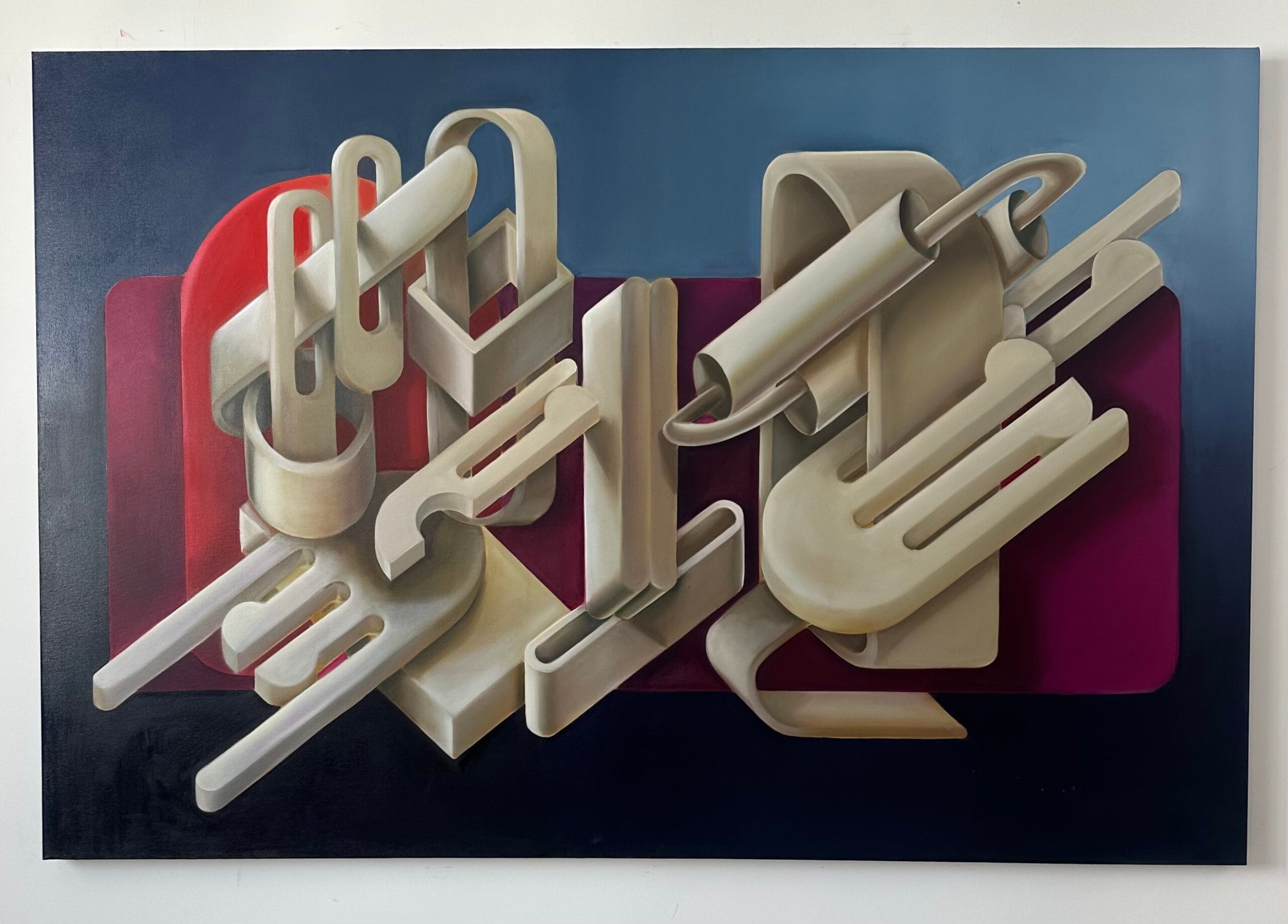
Right now, I'm preparing my next solo exhibition with Galerie 38 in Marrakech. It's an exhibition that continues to explore the theme of hope; it's built around the series of oil paintings "Factory of Hope," which explores the mechanics of hope and asks the following question: how do we create hope in the era we're living in today? How can we believe in progress again, how can we redefine progress, and how can we reclaim the tools we created to improve our lives?
To learn more about Meriam Benkirane's work: Website and Instagram.
Are you looking for affordable floating frames for your artwork? Kolekin frames are the solution!
- Easy at-home assembly
- Affordable (but with a gallery look!)
- Free shipping on orders over $50
