


Known for her striking depictions of urban spaces, Gillian Richards brings together a spontaneous touch and a keen observational eye. In this interview, she speaks about colour, process, improvisation, and the challenge of finding moments of beauty and connection within the overlooked landscapes of everyday city life.
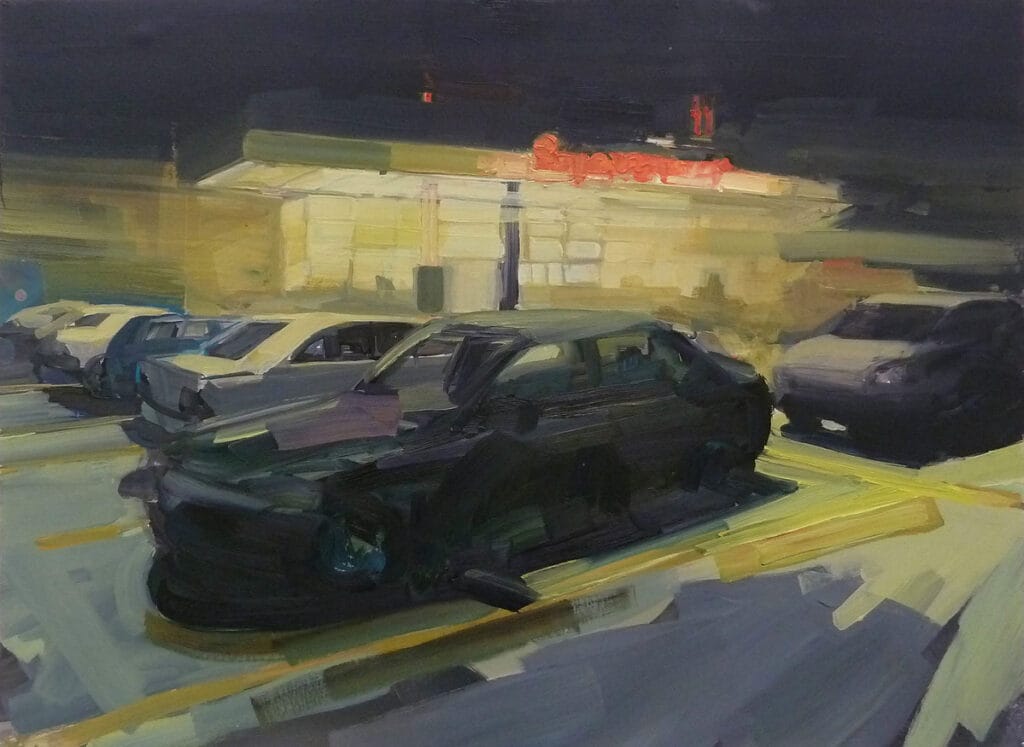
How has your experience working as a scenic painter in the film industry influenced the way you approach painting today?
That work was great technical training for many aspects of painting. I learned about colour mixing and about a wide variety of materials and approaches to painting. Each project demanded improvisation and invention. The other part of the job was working with other artists on huge backdrops or murals. It was through these projects I learned to render objects and architecture broadly and quickly. Often working on the floor, we used rollers or large brushes attached to sticks to put in major shapes quickly. At times, portions of a backdrop could look like an abstract painting to me, but stepping back, the image would come together into something recognizable. I love that in any painting, where the closeup view of a work fragments into something abstract.
You often work on a coloured ground, often bright orange or pink. Where does that habit come from, and what does that ground do for a painting that white wouldn't?
I first used a conventional ground of burnt or raw sienna when I did "plein air" landscape painting years ago. Later I began to experiment with more unusual grounds like hot pink, bright orange or bright lime green. Working on a coloured ground does a couple of things: Where the edges of forms and objects almost meet and the coloured ground peeks through between shapes, a sort of vibration of colour can occur. The other advantage of a coloured ground is its influence on the layers of colour painted over it. To achieve luminous colour I use semitransparent layers in some areas of my work so that the ground comes through.
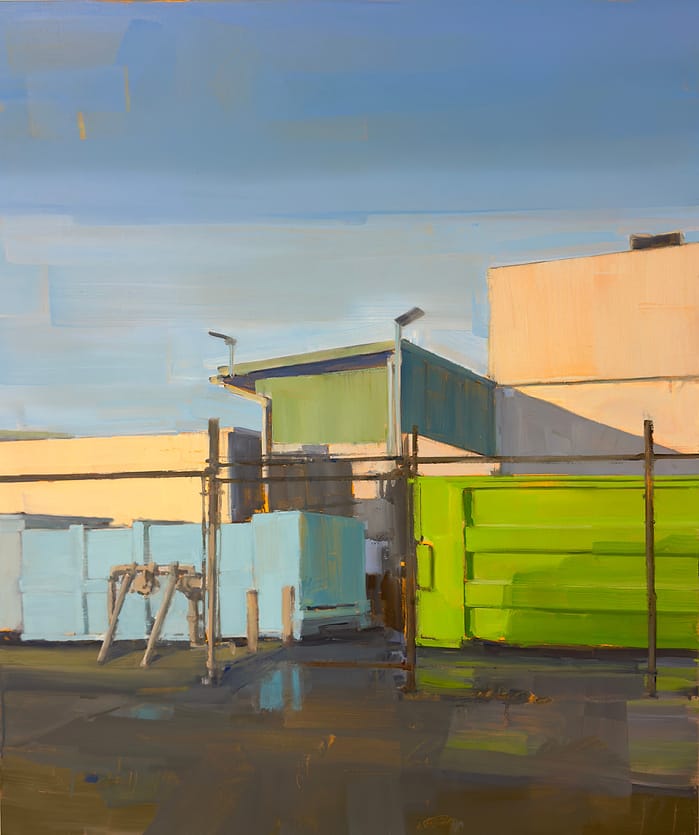
You photograph your everyday surroundings with your phone. What makes you stop in your tracks during a walk or an errand?
It can be the way a shadow falls across a wall or pavement and travels up and over shapes, delineating their form in an interesting way. I look for compositions of light and shadow in my daily environment too. Sometimes I photograph objects like a cell tower, a huge electronic sign or traffic barriers for their interesting shapes. I view these objects as sculptural and sometimes a little absurd, yet so ordinary. So, I also imagine playing with that aspect of their absurdity when I am photographing them.
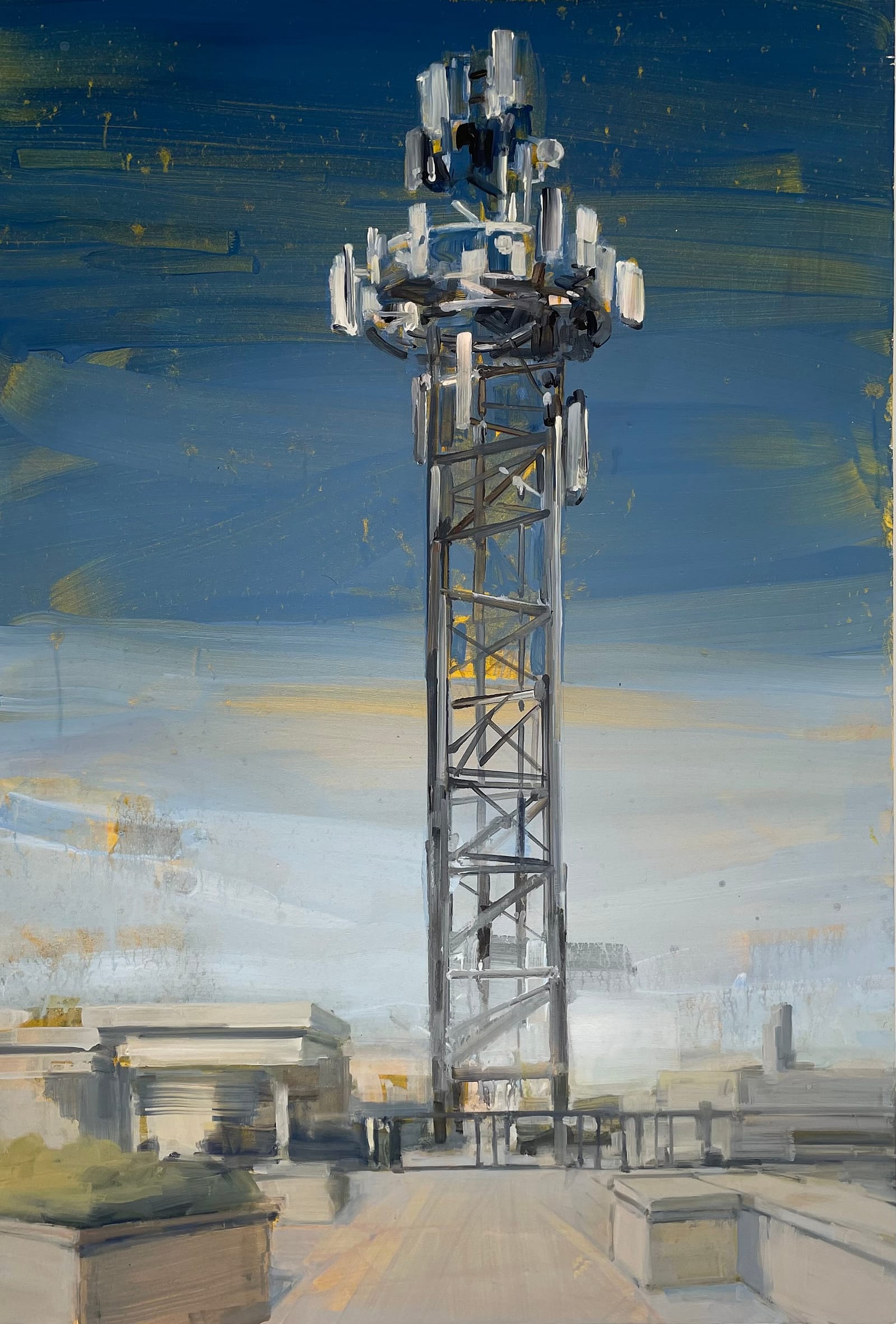
Walk us through your creative process, from the initial idea to the finished work.
I sort through the many photos I take and select the most compositionally interesting and compelling in subject matter. I check them out in black and white with my phone editing app to see the composition more clearly, or flip them around which also helps me to see. From there I may do a few sketches to make adjustments to the composition to determine if the image is going to work as a painting and what size canvas will suit the imagery.
Over a coloured ground on canvas, I trace the image in pencil from the projected photo. I make alterations at this point, moving objects around a little. I use a thin paynes grey to block in the darkest areas and delineate the major forms with lines. From here I like to use large brushes to "lay in" major shapes to establish the composition quickly. I have been experimenting lately with tools other than brushes, like rollers and foam brushes to put in these large areas of colour.
I paint fairly intensively for the first day, and then usually for two or three days longer I work more slowly, deciding what areas need to be emphasized or what areas should be simplified. I work toward areas of detail, usually leaving their rendering to the end. Sometimes I come to an impasse about three quarters of the way and have to put the painting aside to start a new one. It can be weeks or months before I am able to look clearly at the painting to see what it needs for completion.
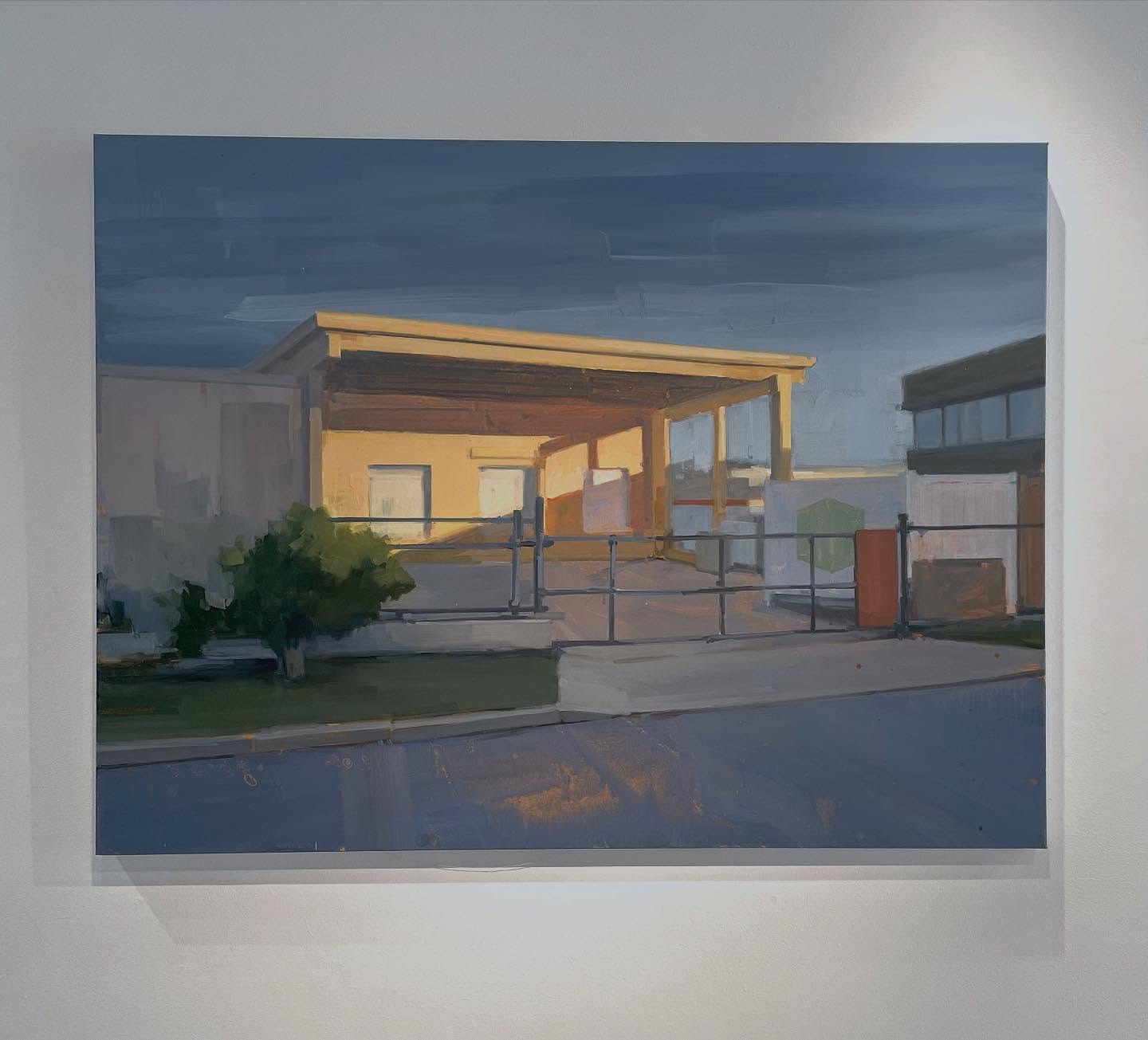
In your work, you often seek to reduce architectural forms to their essence. What guides that process of simplification, and how do you decide which elements to keep or let go?
My decisions about what architectural forms I will simplify begin early on in my process as I consider the whole composition. As I paint it becomes apparent what needs to be brought out in more detail or what needs to be simplified.
You work mostly in acrylics. Why that medium over another?
I usually work in acrylics, but for the last year I have returned to using oils. I went back to oils because I have been trying to make acrylic paint behave like oil paint by keeping it wet or "open" for as long as possible by spritzing it continuously and putting my canvas on the floor so the paint doesn't run. Both mediums have their benefits, and I am at a place these days where I can't decide which to use. It's been a painting by painting decision of late.
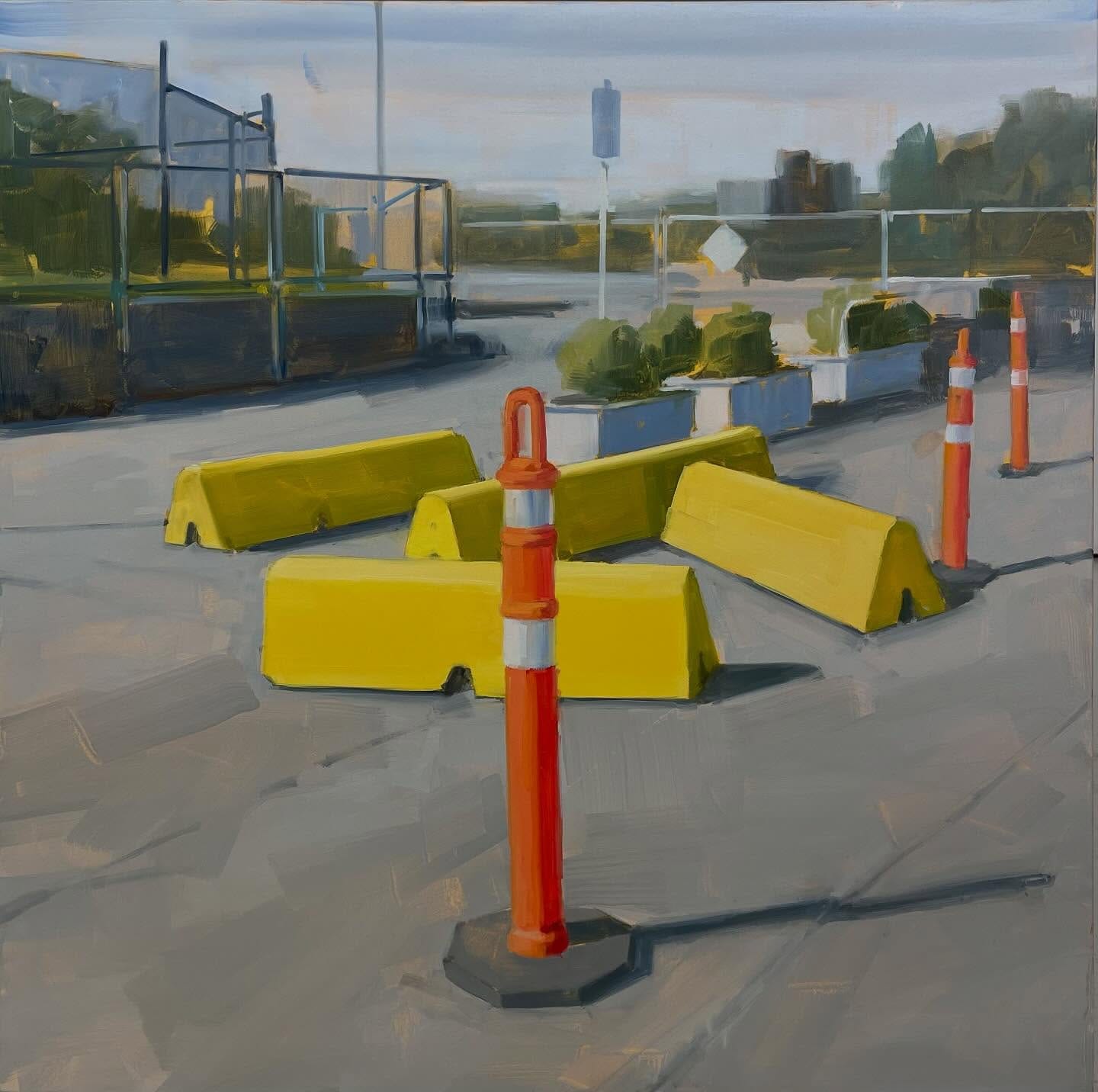
You speak of "reconciliation" with the urban landscape. Is painting, for you, a way to make the city feel more livable or more human?
Yes, I think that is a good way to put it. There are desolate spaces in the city that can be quite inhuman. I try to stay aware and open to seeing interesting aspects and compositional possibilities within these spaces. It makes living amidst our car-centered urban environment feel not so hostile. Of course there are beautiful places within my city too, but I take it as a sort of playful challenge to see the "ugly" parts as interesting.
Name an artist, contemporary or not, who inspires you, and tell us why.
My favorite is the modernist American painter, Richard Diebenkorn. He comes up as a favorite of many artists I know. His compositions are brilliant and his paint handling is free and immediate (unfussy!) and his colours fresh. His paintings feel to me like they are filled with air.
Tell us about your upcoming projects or exhibitions.
Currently I am in a two-person show with Emilie Fantuz until May 30, at the Pendulum Gallery. Pendulum Gallery Exhibition – Current
In early September I will be in a group show of four painters at Viva Alliance in Vancouver. https://vivaalliance.ca/
In April, 2027 I will be having a solo show at This Gallery in Vancouver. https://thisgallery.org
I will be participating in Vancouver's Eastside Culture Crawl this year too. It is a huge yearly event in this city where hundreds of artists open their studios to the public over the weekend in mid November. Eastside Culture Crawl
To learn and see more of Gillian Richards's work: Website & Instagram.
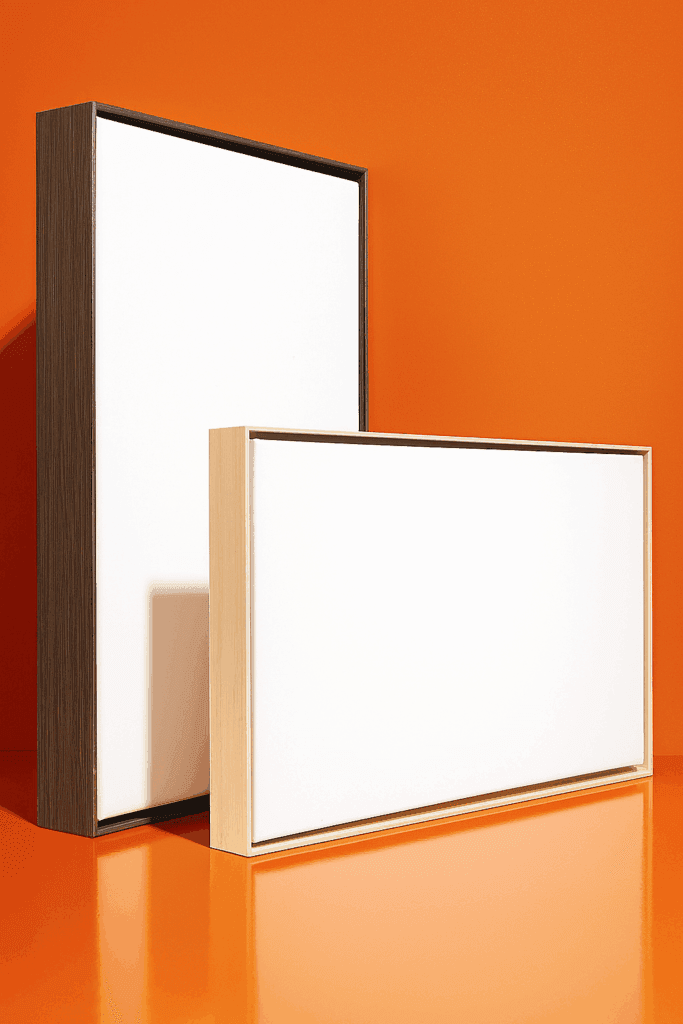
Do you need affordable floating frames for your artworks? The Kolekin frames are the solution!
- Easy assembly at home
- Affordable (but with that gallery look!)
- Free shipping over $50
