


Canadian artist David Shepherd has built a distinctive career by blending classical training with striking hyperrealism. In this interview, he reflects on the lessons that shaped his artistic journey, the inspirations behind his luminous floral portraits, and how discipline, Taoist philosophy, and ambition continue to guide his work.
You started your career as a self-taught artist before studying for 4 years at the Academy of Realist Art. What impact did this choice have on your career?
I think it had a great impact on my career. The decision to go out and show my work in a professional setting. gave me a lot of room in my mind to plan my career while I was in school. There's the experiences of interacting with galleries, and framing shops, clients, hustling around trying to make things happen. It's an important learning experience everyone goes through when they're starting a business in the beginning stages. When I was at school I could combine the skills I was learning with the past experience to try to come up with a framework for how I would make a career happen.
What is the greatest technical lesson learned at the Academy of Realist Art that remains at the heart of your process?
The single biggest lesson would be doing things from big to small. An example, with drawing you would begin with the biggest simple shapes or lines of an object. Once you know those bigger lines or shapes are the correct size/place and angle you can reliably break things down into smaller and smaller pieces confidently knowing that things are in the right place and right size. Interestingly I've found that the idea of big to small is very applicable in a lot of other things in life. For instance whenever you're trying to learn something new you should learn its fundamentals before the details. Looking at your life you would want to map out the larger goals you have before you start planning the details. There are a lot of different things in life that work very well with this idea.
You decided to explore hyperrealism. What pushed you to make this aesthetic choice?
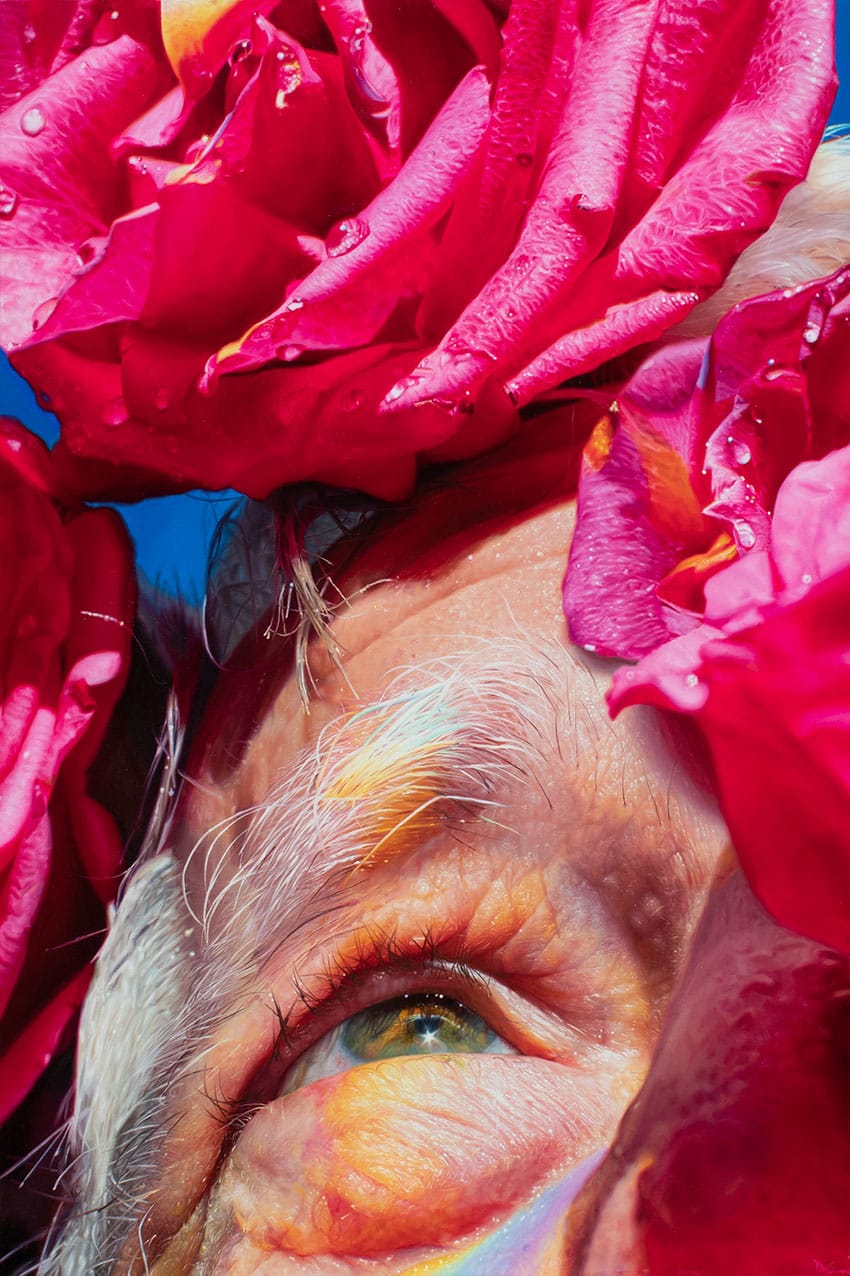
I was having success with Canadian galleries doing either traditional realism or combining different styles of painting together with Realism. However I could not for the life of me get into American galleries. It's just a fact that their market is much larger than Canada's so I wanted to get in. I had shown with different groups like Oil Painters of America, National Oil and Acrylic Society etc but not in any art fairs or galleries. After thinking about it I understood that they have a lot of people that paint traditional realism already and I should do something that would pop, that would really stand out. I had seen some work by an artist, Mike Dargas, which initially got me interested in Hyperrealism. The artist that really inspired me the most as far as Hyperrealism is Marlyn Minter though. I think her work is very moving emotionally, and was incredibly well made technically which is very important to me. Viewing her paintings gave me a lot of inspiration to make something as emotional.
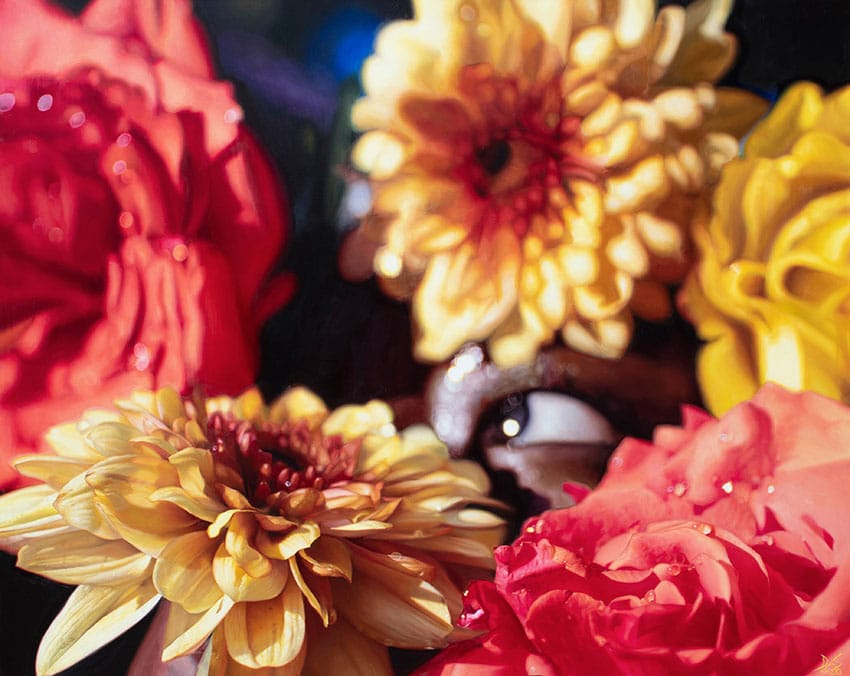
Where did the idea come from for the series of close-up paintings of faces beneath flowers, with that particular light?
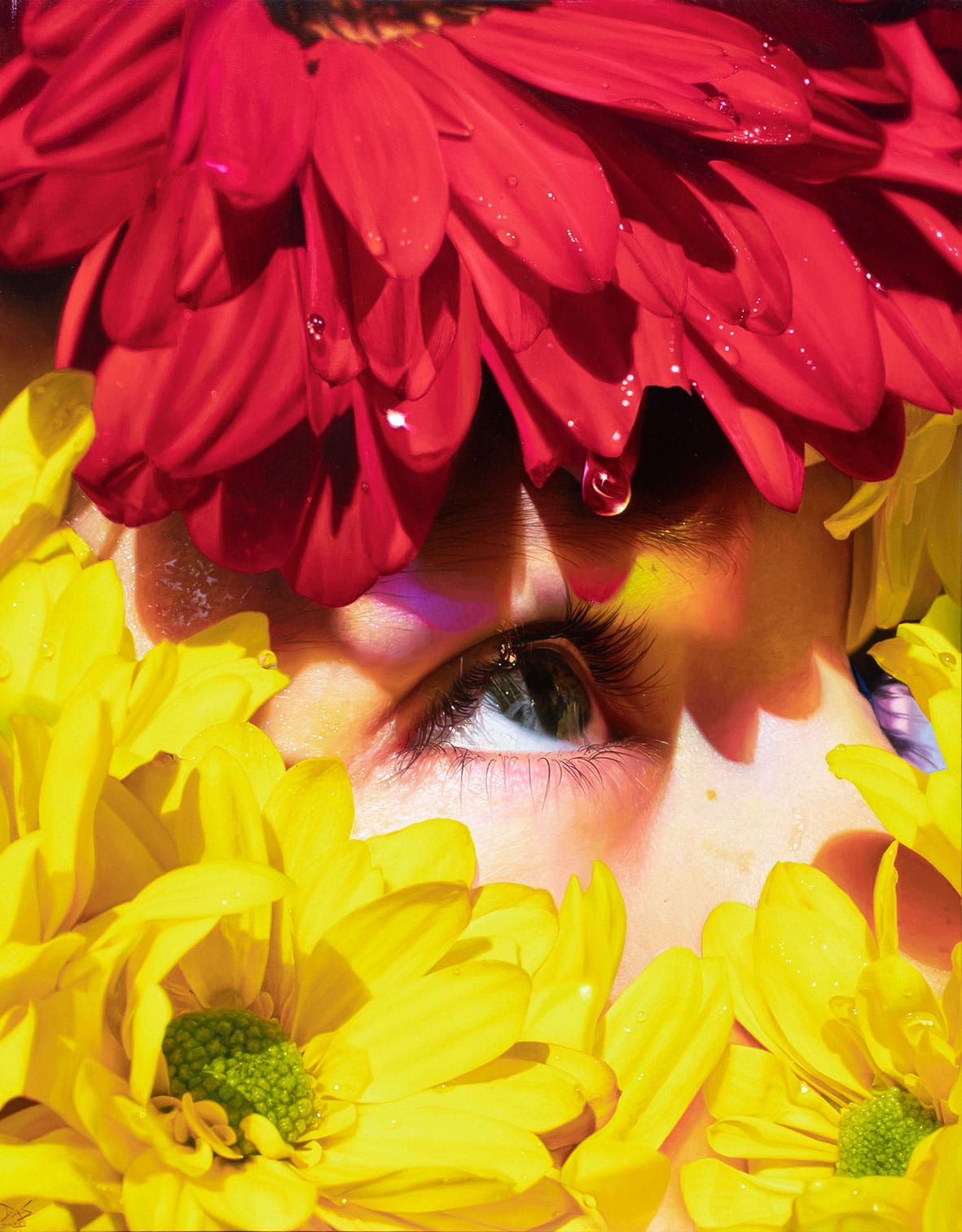
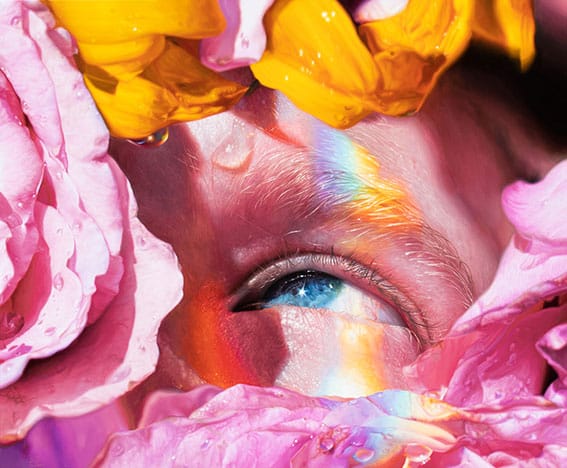
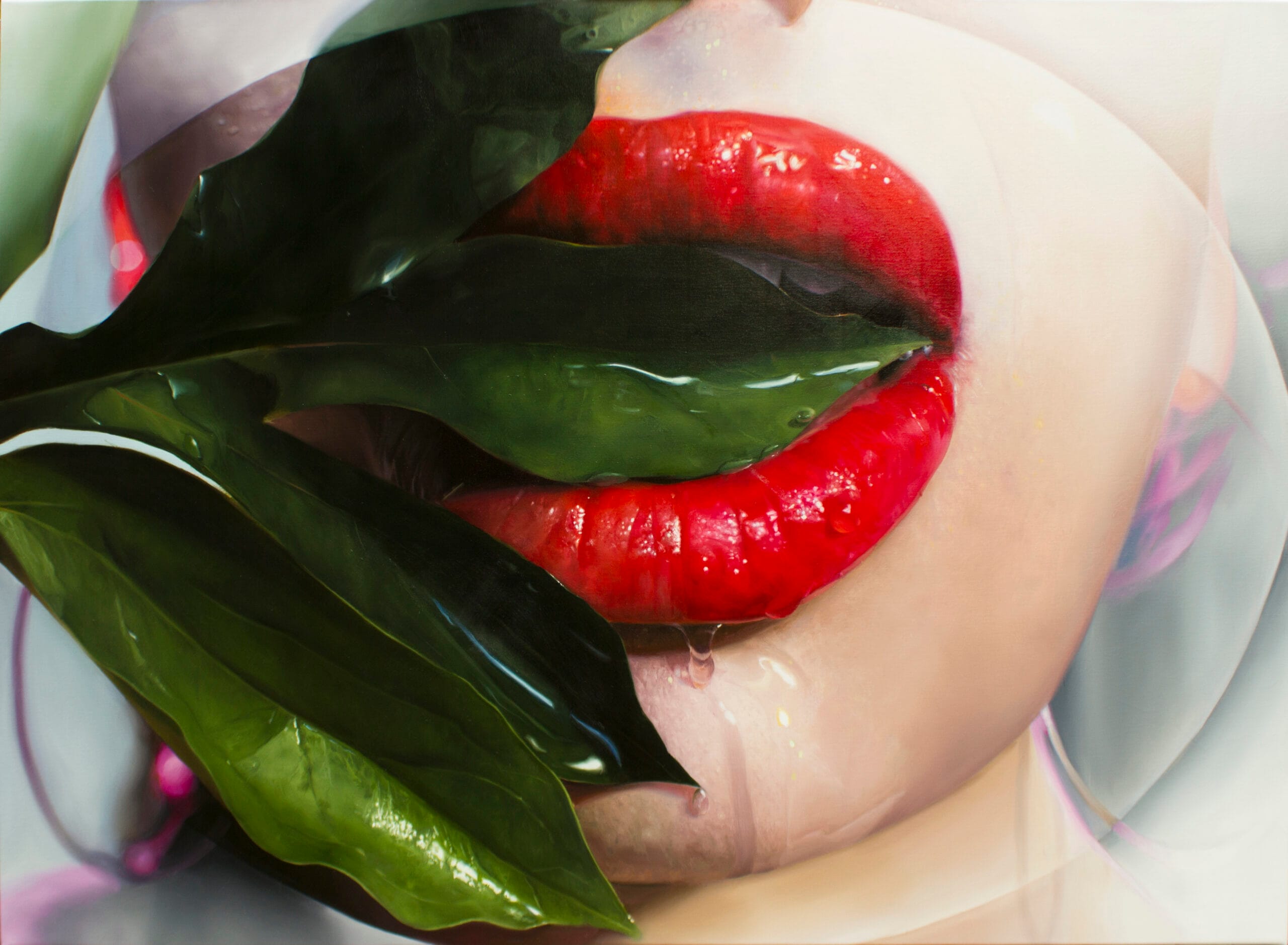
When I started making Hyperreal paintings I wasn't sure exactly what to do and made a small series with different liquids being poured on the models face. These paintings can seem very sensual but I knew I needed to make something that was more me. I was kind of just mimicking what was already out there and it just didn't suit my personality. So I made a point of going to a coffee shop to sit down and think about what I could do, and the idea came to me just out of nowhere that a person's eye, up close surrounded, would be hard to know if it was a man or a woman, and I liked the idea of using flowers. I did some paintings without the Light Prism before deciding that would be a cool and symbolic effect to add to the paintings.
Being represented by gallerists in both Canada and the United States, what are the main differences between these two markets in terms of collectors' tastes?
Both Canada and the U.S are similar in that different regions will have different preferences. However if I'm forced to say a major difference between countries it would be that in the U.S they absolutely love representational painting. That's a painting that is realism but much looser. Instead of trying to make something look perfectly real you clearly see brush strokes but it's still a very accurate picture. From what I've seen you probably won't win any awards painting realism down there unless you paint representational. In contrast Canada (and the U.K) often prefer a much more accurate, tight painting.
You are a follower of Taoist philosophies. How does this influence your relationship with painting, a medium that demands enormous patience and control?
Taoism talks about action without thought. This would be true of anyone who becomes highly skilled at something but it's also true for me. When I'm painting there is very little thought. My mind will in a fraction of a second calculate what needs to be done, but the actual physical action of drawing or painting takes no thought in my mind. Where it has had a greater impact would be my psychological make up which affects my choices for composition and style.
Is there a particular artist who inspires you? And why?
When I was younger it was Dali, Rembrant, Caravaggio, Titian, Vermeer, a lot of older paintings that I would see in books really set me on the journey to start painting. I figured if it didn't work out I could always teach but I would want to at least know how to paint as well as they do. The idea of doing that really attracted me. Later on, as I mentioned with Hyperrealism, Marlyn Minter has some series of paintings that are incredible and I look forward to tracking some of them down and viewing them in real life.
Do you have any upcoming projects or exhibitions you'd like to tell us about?
Vancouver Fine Art is a gallery I'm showing with and they have just moved to a much nicer location on Granville Island. I'm looking forward to seeing what the new gallery will look like when its renovations are completed! Although I am showing with some galleries already I'm interested in finding a permanent gallery in London, California or Miami to work with. I'll be on the lookout this fall and approach some galleries with new work.
To learn and see more of David Shepherd's work: Website & Instagram.

Do you need affordable floating frames for your artworks? The Kolekin frames are the solution!
- Easy assembly at home
- Affordable (but with that gallery look!)
- Free shipping over $50
