


For Nicole Schultz, the frame is far more than a finishing touch. It is an active part of the artwork itself. Drawing on a background that spans fine arts, custom framing, gallery ownership, and entrepreneurship, Schultz has developed a unique visual language that merges precise geometry with expressive abstraction. We spoke with her about the evolution of her practice, the ideas behind her fractured compositions, and the artists who continue to inspire her.
How would you describe your work to someone discovering it for the first time?
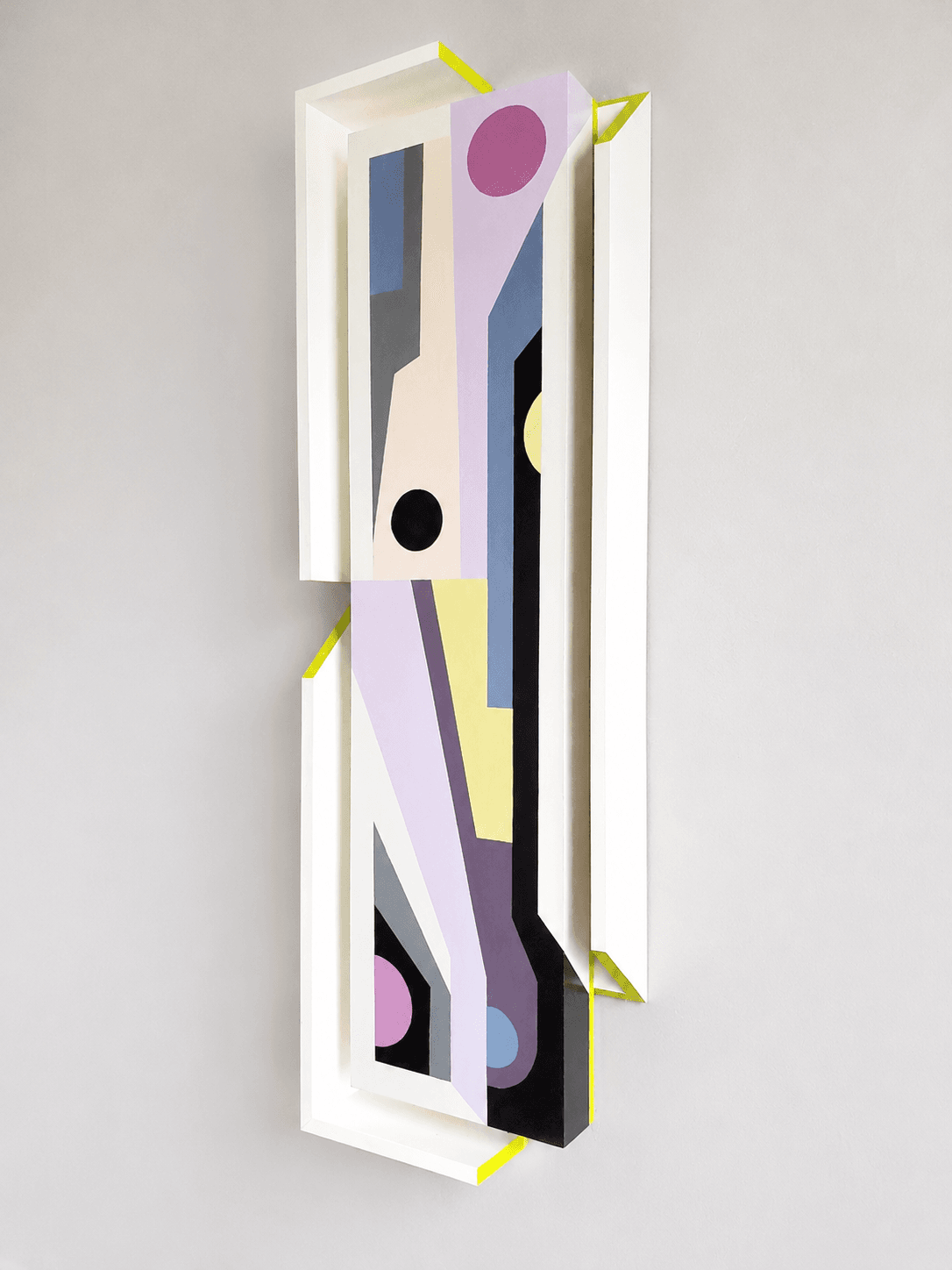
The work is abstract in nature, in a few collections that include stronger geometric based work, and some more organic, free-flowing. The work is done in a hard-edge painting style that incorporates a sculptural framing technique I developed that has evolved over the years to now incorporate elements of relief, assemblage and mixed media.
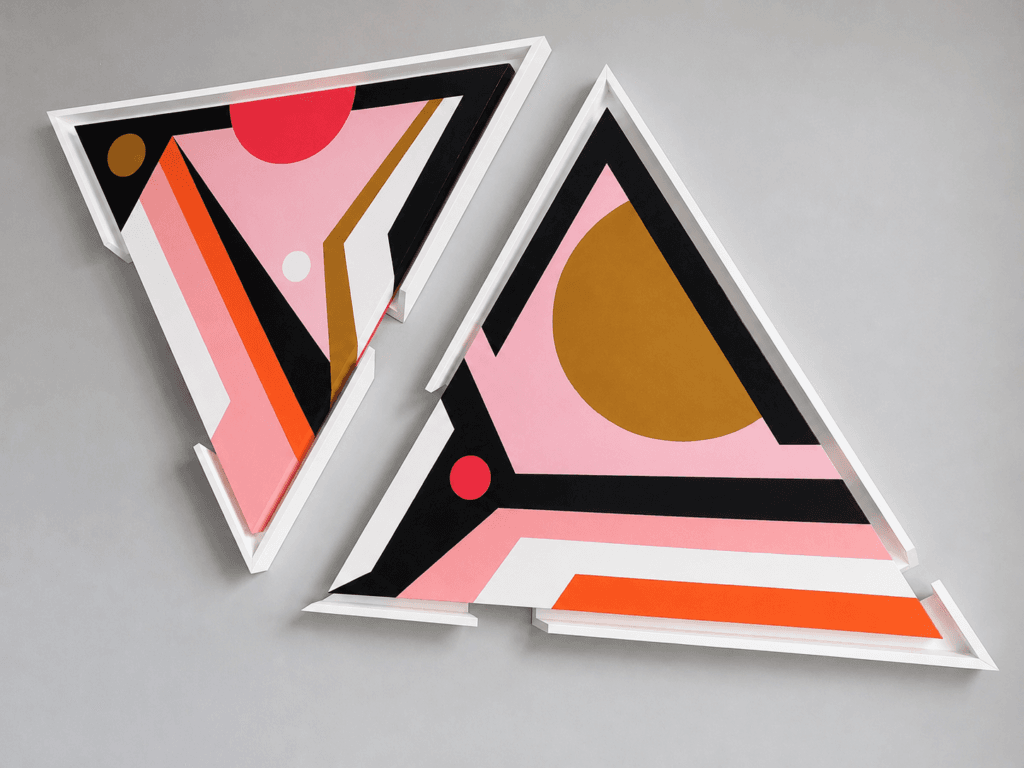
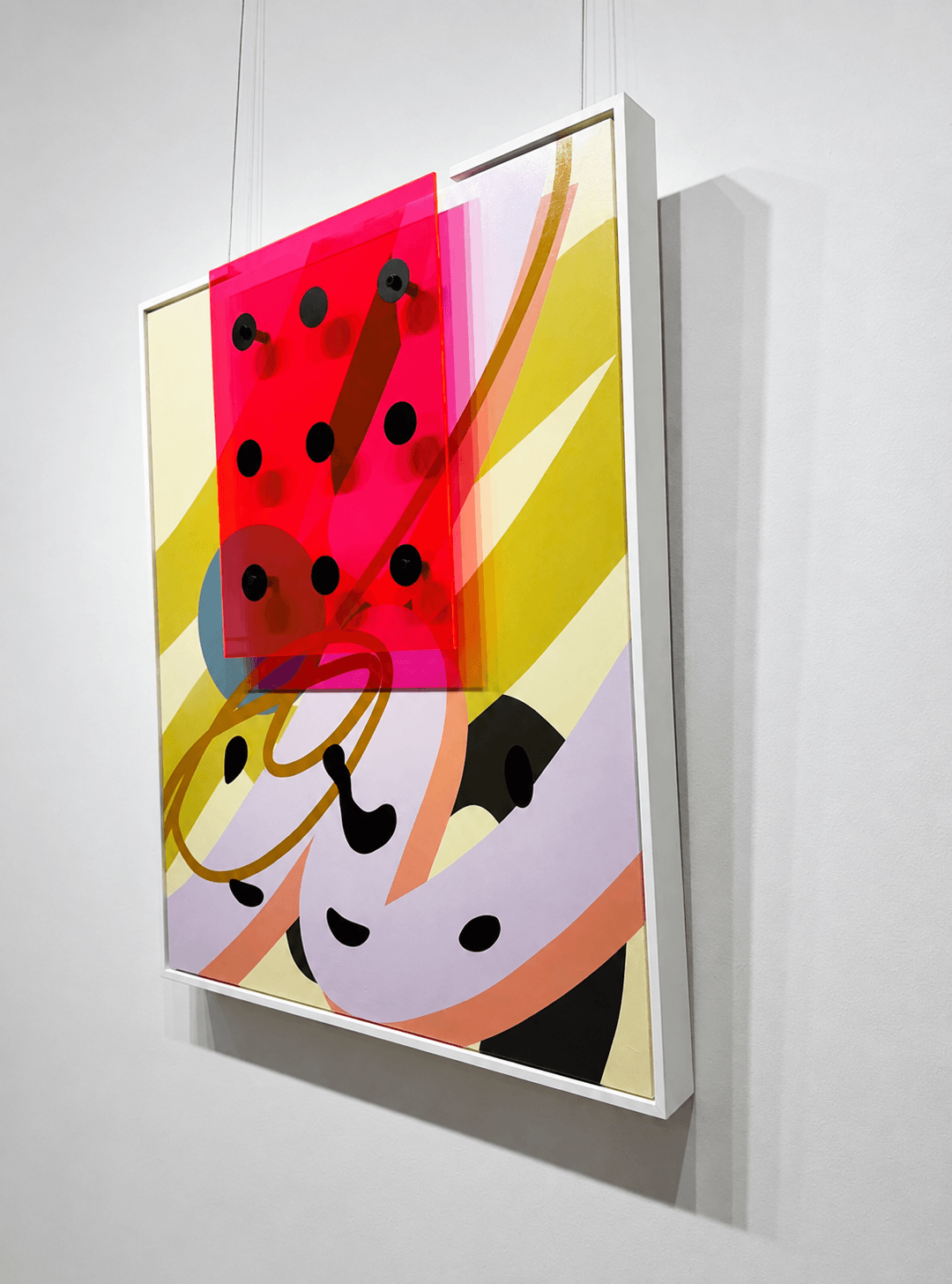
My practise is a mix of painting and sculpture, as the painting bursts through the framework to play with light and shadow, depth and angular optics. I use the term Fractured Frames to describe this deliberate splicing of the float frames that drives so much of the narrative in each piece. Each is custom cut to suit the painting - some are simpler, cleaner, and some are more intricate, angular and complex. Some are doors and windows in or out of the piece, and some are free-flowing pathways through it. Others are bursts of explosive shrapnel like energy, radiating geometry.
Bold colour palettes, intricate in their combinations, mixed with multi-layered hard edge expressions of line and form.
Your background combines fine arts, education, professional custom framing, and entrepreneurship. How has each of these experiences influenced your artistic practice today?
Fine Arts is my first love, and what I pursued in University for my BFA, specializing in Studio Art, or art-making. Through school, I worked part-time learning the craft of Custom Framing - I wanted to do something complimentary to my degree, and loved the history and romance of the framing tradition. I was hooked - so much so, after I completed my BFA and B.Ed, and had been framing for years, I dove headfirst into opening a 4300 square foot commercial gallery space and frame shop. I was combining my passions and wanted to actively be working in my field. Although I had pursued education, and got my degree, I realized I wanted to actively be working with my hands on my passion in my field, and I was filled with angst to feel like my focus wouldn’t be on my own practise. I was 25 and deciding to turn my passion into a business came easily with the excitement I felt - it was an exceptional motivator. The business was great, and I ran it for about 8 years, until COVID hit and things became very complicated for small businesses. I sold the business and dove back into art making full time - which led me to The Benz Gallery in London ON, who began showing my work in their gorgeous space, and eventually I worked with the Gallery to open a new framing studio within their space - this has been such a great ride, and rebuilding something different that gives me 50/50 working time with my framing and with my art has been so wonderful. And, it’s a great team to be apart of!
Working with other artists in my own Gallery was extremely rewarding, and gave me a ton of insight into the business of art - making and selling, preparing and polishing for shows, etc. I loved it. I think it’s helped me be very intentional now, about who I work with and how my work is being represented.
Additionally, my artistic practise developed in response to my work as a framer for sure. I have always been a painter, but once I really dug into my craft as a framer, and woodworking, it began to speak in response to the paintings. Framing became another medium I could play with, sculpt and form a marriage with the artwork.
The frame traditionally acts as a container for the piece, a house that enhances and finishes the work within. It took years into my framing experience to develop the idea and technique to break the container so-to-speak of the framing tradition, and allow something new to push through. Learning the rules in order to break them, as they say!
I think my work as an entrepreneur gave me experience in taking risks and trying new things - and this definitely helps my practise as an artist, and it helps the way I view my practise as well. How I structure my time, how I devise my plans for the work, pricing, assembly, photography and how I create and catalog my work.
You describe your work as Geometric Expressionism. What does that term mean to you?
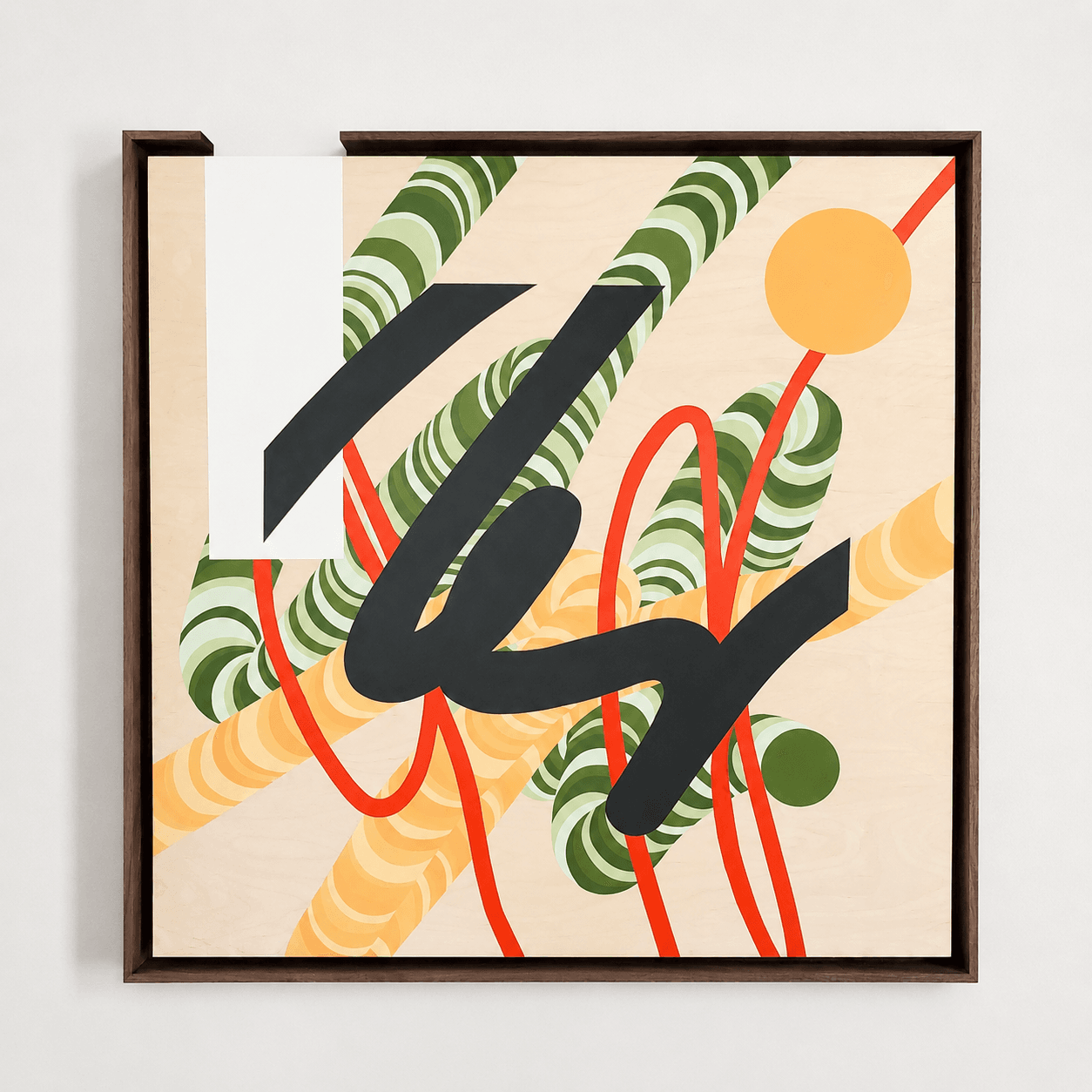
I would consider the work to be in the genre of Geometric Abstraction, but to pin-point it further, it drifts into the realm of Geometric Expressionism for me, in how it combines layers of gestural, intuitive, expressive strokes in clean hard edge controlled structures. These pieces begin as gestural expressions that once layered, begin to create a narrative of energy and raw emotion, filled with the tension of controlled freedom.
I love the tension and juxtaposition of the raw expressive energy and emotion becoming precisely shaped and tightly controlled onto the panel. Shape and geometry become emotional language - line and form dance together to create relationships… It’s all very romantic to me.
Your compositions appear incredibly precise. How much room do you leave for intuition or unexpected discoveries during the creative process?
The process begins extremely loose, raw and expressive in preliminary sketches. I consider these as outlines for the larger pieces, but know well by now, that sometimes things look different at full scale - feel different, and need adjusting. The painting style is quite rigid in precision, yes, but not in its conception, and changes are always being made. I craft my colour palette before painting, which is a meticulous process, and again, very controlled, but even that is subject to change or edits. I sit with the piece as it evolves and feel its energy - sometimes a simply colour swap to one layer changes the entire energy of the piece. Takes the feeling from drowning to swimming so-to-speak. It’s amazing the energetic and emotional capabilities of colour.
The preliminary phase is quite experimental in nature. This is where I really mess around with colour combinations, explore the merging of techniques and the strata of layers in the piece, textures, etc.
Many of my favourite pieces have been playful experimentations that lead me far from my weathered path, and into a place of discovery. Those unknown spaces of excitement mixing with intimidation about how to effectively pull off an idea are some of my favourites.
This is where I find creativity really comes alive to greet you on a mystical level.
You mention mysticism and abstract storytelling as important sources of inspiration. Could you tell us about a particular piece that best embodies those ideas?
I think as mentioned, when you are in a flow-state with creativity, and you are venturing into unknown territory, you drift off the familiar path you are on as an artist, and things really start to get charged. That’s when I feel the energy of the creative force the strongest. It’s this feeling that for me, takes on a mystical quality in the way that it sometimes feels like you are really tapping into something Other - the creative force, or creative energy. I often wonder what it is that drives this, and what we are connecting with - this beautiful wave we all get to surf when we are in the flow. It brings me back to similar feelings I’ve had in meditations - when you tap in. Perhaps a collective creative consciousness, perhaps your higher Self, whatever resonates with you!
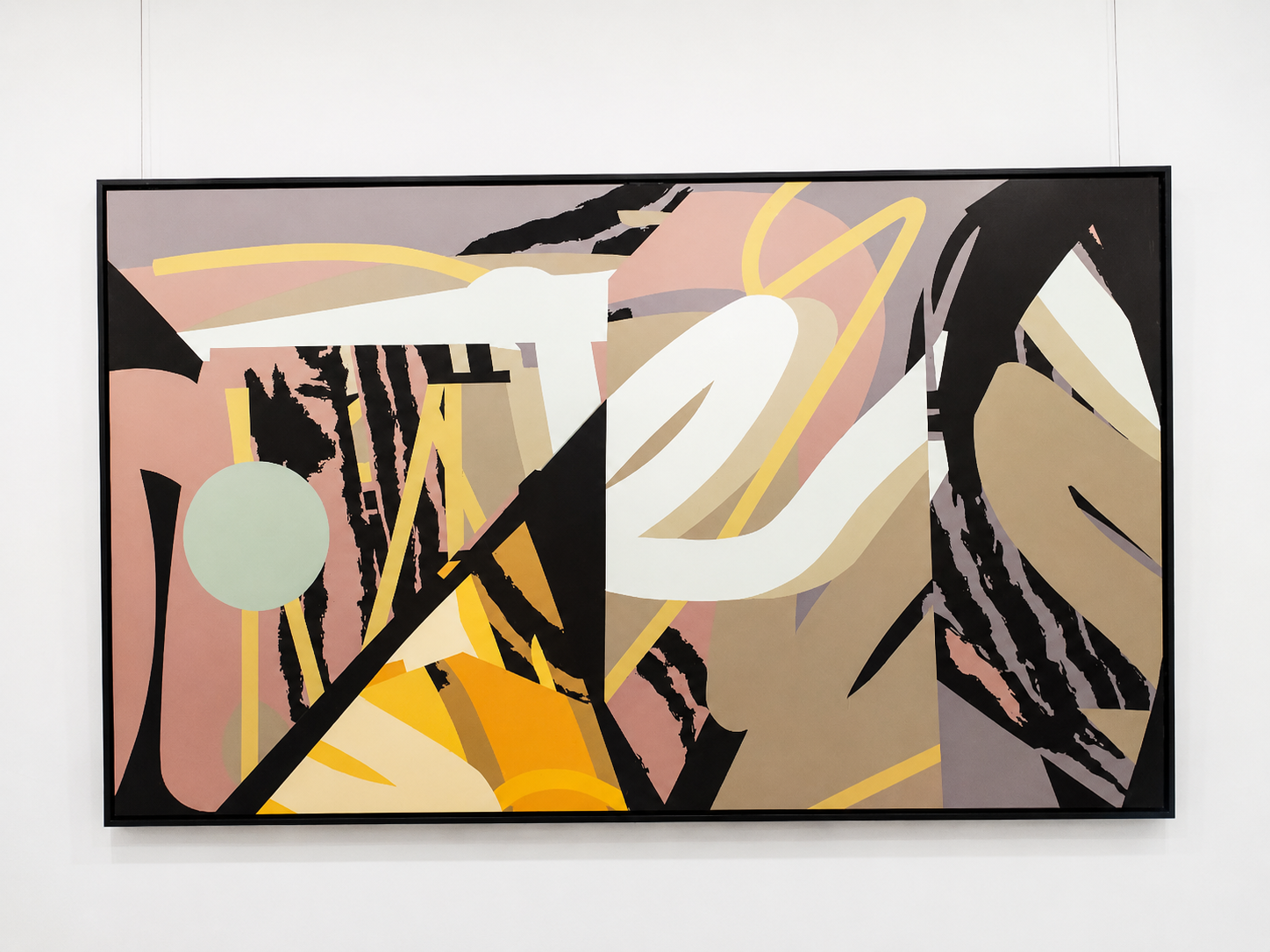
A recent piece that embodies these ideas is Lifting The Veil, a 36x60” piece that explores glimpsing behind the curtain of reality, shapes and textures kaleidoscopically shifting in and out of view, fracturing both the forms within the painting, and the frame. This was a meditative inspired piece, for sure. The piece opens a veil in the painting, allowing the viewer a glimpse into another reality or dimension. Light and colour change in a small section of the piece, as the window is opened in the frame. A consciousness or spiritual opening of sorts.
The titles for pieces always come after completion, once I’ve experienced the vibe it had working on it, and have sat with it’s conceptual energy.
This piece was intricate and complex, with a new focus on light, shadow and texture within the work, and how to open up space and dialogue. I finished the piece, and titled it.
About a month later I read about one of my favourite artists, James Turrell, who works with light and space and colour in large scale installations - He had just opened a major solo exhibition at Gagosian, entitled Lifting the Veil, creating quiet, spiritual environments with light and space. It’s just interesting, in terms of talking about a creative consciousness we tap into - and also just the different ways we use colour, light, and abstraction to tell stories or emote these feelings and concepts. It seems appropriate to use an abstract visual language to represent these abstract intangible concepts and feelings.
Sometimes it seems like when you are in the creative flow, these connections start to emerge. You are lost in the work and when you step back, suddenly everything you have been going through is there on the panel - channelled into the piece in this strange abstract language. I like those moments when you lose yourself in the work, and the conceptual component is subconsciously coming through. That’s getting into the mystical, for me - as one small recent example, but all the pieces tell a story.
After running an art gallery for several years, your perspective on the art world must have evolved. What did that experience teach you as an artist?
Representing other artists, as an artist, taught me a lot about the importance of representation, and being intentional about who you are working with and how they are in fact representing you. How they understand and treat your work, and you as an artist. They are the link between Artist and Collector - they are the ones relaying the ethos of your practise, and I think it’s important that message is relayed accurately for the integrity of the artists work and career. And also that the work is shown to its full potential - the space and the experience of the curation is just as important.
That goes both ways for artist-gallery relationships, of course - the importance of maintaining positive connections, or being picky about your connections, and feeling there is a solid level of trust and the quality of work being done for you.
I read an article years ago about the importance of Galleries earning their commission. 50% is industry standard these days, and that is an incredibly significant split for both parties - the artist is providing free inventory, so I think it really made me look at how the Gallery is working for the artist to earn that commission and make the connections and build their audience, along with sales of course. Artists have more opportunities now with the rise of social media and online sales to represent themselves to a wider audience, so I think that does have a huge impact on the role of Galleries and the pressure on them as well, as all of this is evolving so quickly. Social media was just kind of kicking up when I was running my Gallery, and it has come eons in the past 5+ years since, and is a totally different game now.
And speaking on the idea of representation - I think it did give me a deeper perspective on the responsibility of the Gallery to be very aware of who and what they represent. What voices they are amplifying, whose perspectives they are including - the roster of artists becomes a clear indication of the Gallery’s direction, values and ethics. These are things I pay closer attention to now as a full time artist because of the experiences on the other side of things.
Is there an artist who has had a particularly strong influence on your work? If so, why?
So many.
James Turrell, as I had mentioned previously. Very different mediums, but his work with colour and light, and how it totally transforms space and energy is incredible. His work becomes mystical in a sense as well, which I really love and take inspiration from. How we can translate a feeling, an emotion, a state of mind with colour, shape and light. How our work can transform the space around itself.
Dan Flavin does this with light as well - it feels like they are/were painting with light.
Frank Stella has been a major influence on me through the years, since first encountering his work in University. His sculptural pieces really opened my eyes to how geometry and colour was being used to explore beyond the canvas as a painting, and beyond canvas as a material in general, leading me to explore wood, relief, irregular shapes, etc. I loved his courage in breaking the bounds of contained space.
I also loved how these pieces kept the viewer curious, and that really maintained the aura of the work - they don’t give away the secrets of their practise. This is definitely a learned observation, and something I am always very careful of.
What are you currently working on, and are there any upcoming projects or exhibitions you'd like to share with our readers?
I am currently in a place of exploring new materials in my work, adding plexiglass and transparent elements into the mix, while also working on the fractured collection as it develops.
I do have a few exhibitions in the works, and will definitely be sharing them as I am able to in the upcoming months! I post all updates on my Instagram, so feel free to follow along!
To learn and see more of Nicole Schultz's work: Website & Instagram.
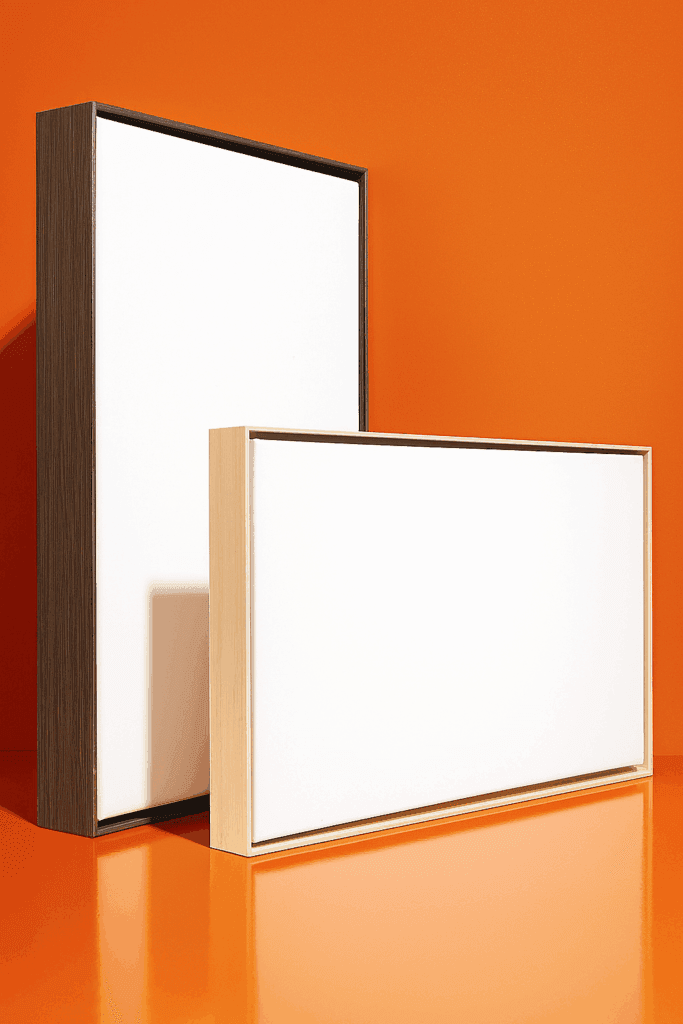
Do you need affordable floating frames for your artworks? The Kolekin frames are the solution!
- Easy assembly at home
- Affordable (but with that gallery look!)
- Free shipping over $50
